High-Performance Pallet Racking & Mesh Deck Systems
Manufactured using high-tensile Q235B/Q355B and ASTM structural steel, certified for high-bay logistics, seismic resiliency, and strict fire compliance.
Top 10 Heavy Duty Mesh Deck Racking Manufacturers & Factories
A rigorous structural analysis evaluating production automation, cold-formed wire quality, ASTM hot-dip galvanization, and compliance with global seismic and racking standards.
Steel King Industries, Inc.
Widely recognized for its heavy-duty SK2000 closed tubular frame and SK3000 hot-rolled structural steel channel racking. Steel King pairs high-gauge wire mesh decks with welded structural channels, setting industry benchmarks for torsional resistance and forklift collision resilience in high-throughput fulfillment centers.
Dexion Storage Solutions
An engineering authority throughout Europe and the Asia-Pacific region. Dexion produces precision-tolerance pallet racks combined with fire-rated zinc-electroplated wire decking. Their systems are widely deployed in automated cold-storage facilities where tight beam deflection tolerances are non-negotiable.
Mecalux Racking Systems
Mecalux stands among the largest automated storage manufacturers worldwide. Their heavy-duty wire mesh panels feature integrated inverted channels to eliminate dust collection and provide seamless interfaces with automated shuttle runners and AGV transport routes.
Frazier Industrial Company
As North America's premier hot-rolled structural steel rack specialist, Frazier manufactures heavy-duty structural frames engineered to outlast standard roll-formed racking. Their wire decking channels utilize heavy 2-gauge to 4-gauge drawn steel, ensuring structural integrity under severe forklift abuse.
SSI Schaefer Group
SSI Schaefer excels at high-bay, clad-rack warehouses. Their wire mesh shelf inserts conform strictly to FM Global and NFPA 13 sprinkler penetration standards, offering open-area airflow ratios up to 72% for accelerated smoke venting and uniform fire-suppression water flow.
Jracking Group
A massive production base specializing in cost-effective, high-volume automated storage rack manufacturing. Jracking produces precision stepped and flared mesh decks with robotic multi-point resistance welding, allowing rapid delivery for global EPC contracts and 3PL hubs.
Nashville Wire Products
Nashville Wire sets the standard for dedicated material handling wire products. Specializing in universal flanged decks, inverted channel mesh, and heavy-duty drop-in waterfall decking, their products serve as OEM decking for major industrial rack builders throughout North America.
Stow Group
Stow has become an engineering powerhouse across Europe, especially with its integration of automated shuttle systems and mobile rack units. Their wire decks feature zinc-electroplated finishes with anti-scratch rounded borders to protect operators during rapid manual case-picking operations.
Ridg-U-Rak, Inc.
Ridg-U-Rak delivers high-strength teardrop and slotted pallet rack frameworks. Their mesh decking lines incorporate roll-formed support channels with variable gauge options, custom-designed to handle concentrated point loads, bulk containers, and irregular slip-sheet pallets without beam spread.
Guangzhou OEM Heavy Duty Logistics Equipment Co.
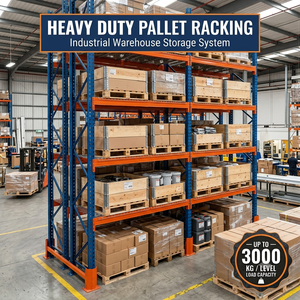
Leading the global supply chain with single-source manufacturing control, from wire-drawing and automated CNC cold roll-forming to robotic multi-point channel welding. Providing fully integrated solutions including 3000kg heavy-duty pallet racks, four-way intelligent shuttle runners, galvanized mesh decking, and prefabricated steel storage structures. Operating with deep engineering support for international engineering projects, ensuring zero-defect load compliance across ambient, pharmaceutical, and sub-zero freezer operations.
Structural Mechanics of Heavy Duty Wire Mesh Decking
Understanding uniform distributed load (UDL), structural channel profiles, and deflection thresholds under ANSI MH26.2 and RMI specifications.
Engineering Principles & Safe Working Loads
Heavy duty mesh deck racking is an engineered safety component designed to prevent pallet drop-through, transfer structural loads evenly to supporting step beams or box beams, and accommodate non-standard load units. Unlike solid timber or steel plate decking, mesh decking maintains code-mandated vertical airflow and sprinkler water penetration.
The structural load-bearing capacity of wire mesh decking is governed by three primary structural elements:
- Wire Mesh Grid Pattern & Gauge: Typically fabricated in 50×50mm or 50×100mm grid configurations utilizing cold-drawn high-tensile carbon steel wire ranging from 4.0mm (8-gauge) to 6.0mm (4-gauge).
- Cold-Rolled Support Channels: Stamped from 14-gauge (1.8mm) to 12-gauge (2.5mm) structural sheet steel. Channels are resistance-welded to the wire matrix, transferring gravity loads directly to the beam flanges.
- Waterfall Edge Geometry: Overhanging standard 1.5-inch waterfalls prevent deck migration during pallet loading and unloading, acting as an integrated anti-dislodgement safety lock.
Channel Geometries: Step Beams vs. Box Beams
Selecting the correct channel configuration is critical to preventing point-load failure and maintaining the design deflection limit (standardized at L/240):
1. Standard Step Channel (Inside Waterfall)
Engineered specifically for step beams with a 7/8" or 1-1/2" step. The channel ends rest securely inside the step, ensuring flush pallet loading and eliminating snag hazards for reach trucks.
2. Universal Flared Channel
Features flattened, flared ends that span across structural box beams, C-channel structural beams, and step beams alike. Ideal for retrofitting older facilities with mixed beam profiles.
3. Inverted Channel (Hygiene & Dust-Free)
Designed upside down (opening facing down) to prevent dust, wood shavings, and debris from accumulating inside the channel trough. Mandatory in pharmaceutical and food-grade operations.
| Deck Model / Type | Nominal Wire Gauge | Channel Geometry | Channel Qty | Rated UDL Capacity | Deflection Threshold | Safety Factor |
|---|---|---|---|---|---|---|
| Light-Duty Manual Pick | 4.0 mm (8-Gauge) | Inverted Step | 2 Channels | 300 kg (660 lbs) | L / 240 Max | 1.65:1 Yield |
| Standard Distribution | 4.8 mm (6-Gauge) | Universal Flared | 3 Channels | 1,000 kg (2,200 lbs) | L / 240 Max | 1.65:1 Yield |
| Heavy Duty Industrial | 5.2 mm (5-Gauge) | Reinforced Step | 4 Channels | 1,500 kg (3,300 lbs) | L / 240 Max | 1.80:1 Yield |
| Extra Heavy Structural | 6.0 mm (4-Gauge) | Structural Formed C | 5 Channels | 2,500 kg (5,500 lbs) | L / 300 Strict | 2.00:1 Yield |
| High-Bay AS/RS Runner | 6.0 mm Cold-Drawn | Dual Inverted Welded | 6 Channels | 3,500 kg (7,700 lbs) | L / 360 Precision | 2.10:1 Yield |
Enterprise Advantages & Single-Source Manufacturing
Combining heavy structural engineering, automated robotic welding, and end-to-end quality control to minimize procurement risks for international EPC buyers.
Single-Source Accountability
From prime raw steel coiling (Q235B/Q355B) to wire drawing, roll-forming, resistance welding, and electrostatic powder coating — every production step occurs inside our unified manufacturing complex, eliminating third-party markups and quality variances.
Robotic Multi-Point Resistance Welding
Our automated welding gantries perform up to 64 welds simultaneously under digital thermal control. This guarantees consistent weld penetration (>98% bond strength) without burning the high-carbon wire or causing thermal brittleness.
Certified RMI & CE Engineering
Every racking system and wire deck assembly is backed by Finite Element Analysis (FEA) and verified physical destructive testing. Systems comply with ANSI MH16.1, ANSI MH26.2, and EN 15512 specifications, complete with stamped load capacity plaques.
Extreme Environment Finishing
Choose between thermoset electrostatic polyester powder coating (60-80 micron thickness) for ambient distribution centers, or ASTM A123 hot-dip galvanization for cold storage (-30°C) and high-humidity maritime logistics hubs.
Comprehensive Export Documentation
We provide full structural shop drawings, dynamic seismic calculation packages, container loading plans (stuffed to maximum cubic volume without freight damage), and complete Mill Test Certificates (MTC) with each shipment.
Turnkey Automation Compatibility
Engineered to integrate directly with four-way automated pallet shuttles, stacker cranes (AS/RS), pick modules, and automatic guided vehicles (AGVs). Tight dimensional tolerances (±1.0mm) eliminate sensor trips and shuttle stoppages.
Future Procurement Trends in Industrial Racking & Decking
How supply chain executives, warehouse developers, and automation contractors are reshaping storage system specifications through 2030.
Shift from Timber to Wire Mesh Decks for NFPA 13 Compliance
Global fire insurance underwriters (including FM Global) are enforcing strict penalties on facilities using solid plywood or timber 2×4 decks due to flame spread and water shadowing. Modern procurement mandates minimum 70% open wire mesh to ensure early fire sprinkler activation and direct water penetration down to lower tier pallet levels.
Integration Tolerances for Autonomous Mobile Robots (AMRs)
As automated 4-way shuttles and heavy-payload AMRs replace traditional counterbalanced forklifts, rack procurement demands millimeter-precise deflection limits. Buyers now specify L/360 deflection under full dynamic loads, requiring heavier 4-gauge wire decks with welded anti-sway lock tabs to guarantee error-free optical sensor alignment.
Low-Carbon Recycled Steel & Cold-Form Optimization
Procurement audits increasingly demand Environmental Product Declarations (EPDs) and documented carbon footprints. Modern deck factories utilize scrap-recycled Electric Arc Furnace (EAF) steel with variable cold-rolled profile geometry, delivering 25% higher yield strengths while reducing component deadweight and international shipping emissions.
Technology Development Trends in Wire Racking Systems
Pioneering innovations transforming passive warehouse racks into intelligent, resilient material handling infrastructure.
1. High-Tensile Micro-Alloy Wire Formulations
Traditional wire decking relied on standard low-carbon Q195 wire drawn down to heavy thicknesses. Advanced mills are transitioning to micro-alloyed carbon steel enriched with vanadium and boron, achieving tensile strengths exceeding 650 MPa. This technological leap allows factories to produce 4.5mm wire decks that match the structural UDL performance of older 5.5mm decks, reducing overall rack structure dead load and steel tonnage requirements.
2. RFID & IoT Sensor Embedded Deck Channels
Smart logistics hubs are piloting strain-gauge sensor strips embedded inside the central reinforcement channel of mesh decks. These sensors measure real-time deflection and beam loading, transmitting wireless alerts to the Warehouse Management System (WMS) whenever an overweight pallet creates an unsafe deflection condition or uneven load distribution.
3. Advanced Anti-Corrosion Nano-Ceramic Pretreatments
In high-density cold chain operations, condensation cycling during defrost periods causes rapid premature oxidation on standard powder-coated racks. Next-generation factory lines utilize zirconium-based nano-ceramic pretreatment baths prior to powder coating, creating a covalent molecular bond that enhances salt-spray resistance to over 1,000 hours without toxic hexavalent chromium.
4. Modular Drop-In Modular Pick Modules
E-commerce fulfillment requires flexible transitions between full-pallet storage and split-case hand picking. New mesh deck iterations feature integrated snap-in dividers, carton flow roller tracks, and overhead LED pick-to-light rail mounting clips, enabling warehouse operators to reconfigure entire pick faces in minutes without hot-work permits or mechanical bolting.
Frequently Asked Questions on Heavy Duty Mesh Deck Sourcing
Authoritative, engineering-backed answers addressing the most critical technical questions encountered during project specification and international bidding.
What is the structural difference between step channels and flared channels?
Step channels are engineered exclusively for step beams featuring an inward-facing 7/8" or 1-1/2" ledge. The channel ends drop into the step, creating a flush top surface. Flared channels have flattened, tapered ends designed to sit securely atop structural box beams, structural C-channels, or roll-formed beams with no step. Flared channels offer universal beam compatibility, whereas step channels provide maximum stability against accidental dislodgement.
How does wire mesh decking satisfy NFPA 13 warehouse fire codes?
NFPA 13 mandates that rack shelving must be sufficiently open to allow automatic fire sprinkler water to penetrate down through all rack levels to reach combustible goods below. Solid wood or sheet steel decking acts as an umbrella, deflecting water away from internal rack fires. Heavy duty wire mesh decks provide between 68% and 74% clear open area, meeting NFPA 13 and FM Global standards for non-solid shelving and eliminating the need for expensive in-rack sprinkler systems on every tier.
What does "Uniformly Distributed Load" (UDL) mean versus concentrated point load?
Uniformly Distributed Load (UDL) assumes that the total weight of the pallet or container is evenly dispersed across the entire surface area of the wire mesh deck. If a deck is rated for 1,500 kg UDL, this capacity is only valid when the load footprint covers the full span. If heavy products are loaded on small feet or concentrated points (such as skids or heavy machinery legs), the local wire bending moment is significantly higher, requiring additional support channels or heavy structural bar inserts.
When should we specify hot-dip galvanization (HDG) over powder coating?
Electrostatic powder coating is cost-effective and durable for ambient indoor distribution centers with controlled humidity. However, hot-dip galvanization according to ASTM A123 / EN ISO 1461 is mandatory in cold-storage warehouses (-20°C to -30°C), outdoor staging areas, fertilizer and chemical storage, or humid coastal facilities. HDG provides a metallurgical zinc-iron alloy barrier that provides sacrificial cathodic protection against corrosion even if scratched by forklift forks.
What are the allowable deflection limits for high-density and AS/RS racking?
Under ANSI MH26.2 standards, standard wire decking deflection must not exceed L/240 (length of beam span divided by 240) under fully rated load. For automated storage and retrieval systems (AS/RS) and automated four-way shuttle systems, tighter tolerances are specified—typically L/300 to L/360. Excessive deck sag can cause optical sensor misalignment, robotic shuttle jamming, or pallet hang-ups during automatic high-speed retrieval cycles.
Can wire mesh decks be customized for non-standard pallets and bulk boxes?
Yes. Custom OEM manufacturing accommodates non-standard pallet footprints (e.g., 1100×1100mm Asia pallets, 1000×1200mm Euro pallets, or 48×48" chemical drums). Customization parameters include narrowing the wire grid to 25×50mm for small package support, increasing channel quantity from 3 to 5 or 6, integrating inverted channels for food packaging, or adding welded backstops and side dividers for split-case storage modules.
Ready to Engineer Your High-Bay Storage Project?
Consult with our structural engineering department for turnkey warehouse layouts, custom seismic capacity calculations, sample mesh deck fabrication, and direct container factory pricing.