Engineered for Automation Since 1970

AS/RS Racking Systems: Precision Engineering, Millimeter Tolerances & High-Density Storage

Structural integrity meets robotic automation. Steel King Industries, Inc. designs, engineers, and fabricates custom AS/RS racking systems, unit-load high-bay frameworks, and turnkey rack-supported buildings designed to eliminate downtime and maximize cubic density across modern global supply chains.

Send an Inquiry Explore Technical Specs
Unit Load AS/RS Mini-Load Rack Rack-Supported Building Millimeter Tolerances Deep Freeze AS/RS

Unit-Load AS/RS Racks

Heavy-payload structural channel systems reaching beyond 40 meters.

Mini-Load & Shuttle

High-speed case and tote storage frameworks with micro-deflection controls.

Rack-Supported Clad

Integrated structures where racking bears roof, walls, and wind loads.

Extreme Cold Compliance

Charpy V-notch tested steel configurations down to -30°C continuous.

0+Years of structural excellence
±1.5mmRail & crane plumbness control
100%RMI ANSI MH16.1 compliant
GlobalDeployment & engineering support
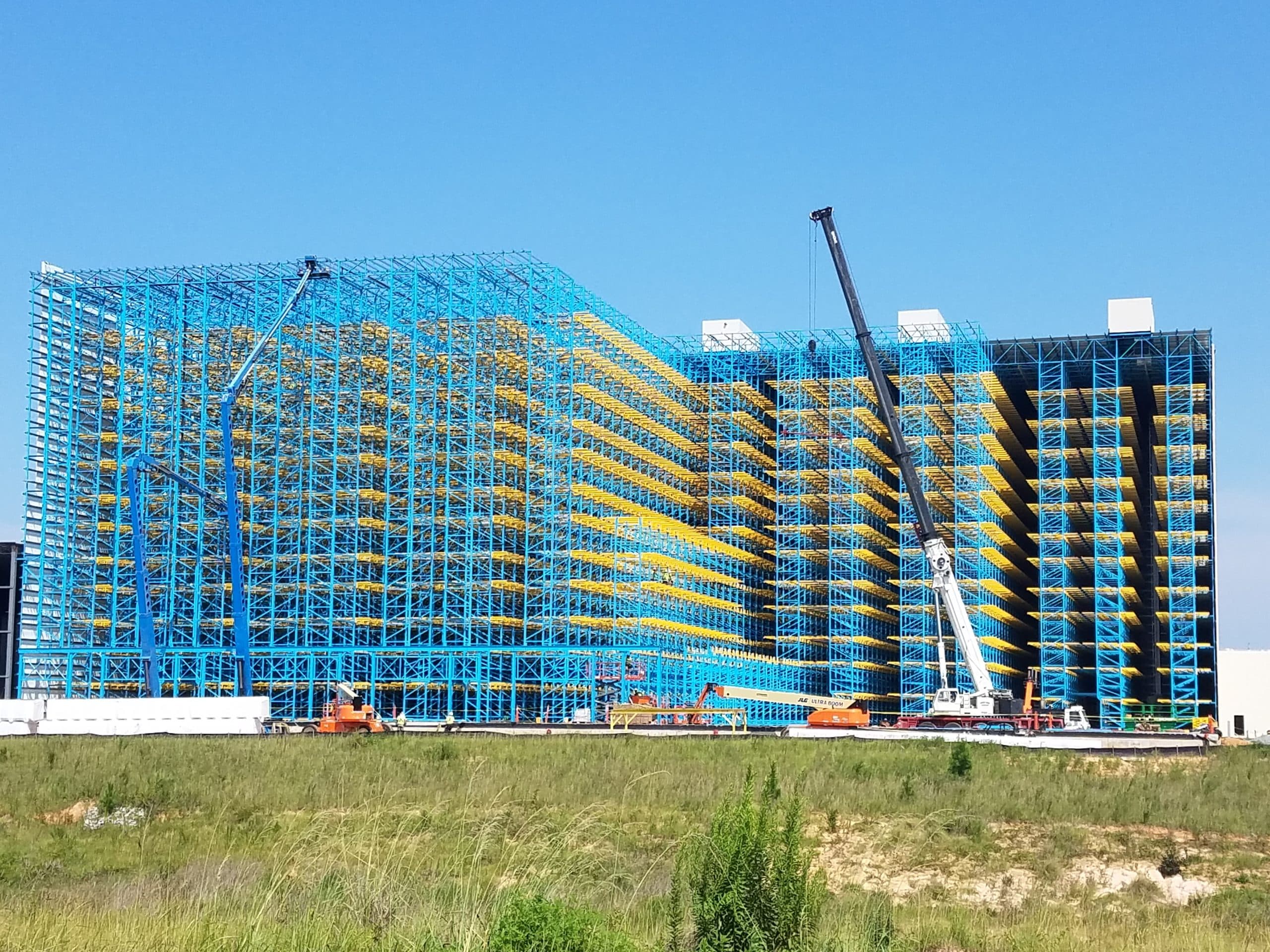
Heavy structural steel AS/RS racking system under construction by Steel King Industries, Inc.
The Backbone of Automation Where mechanical tolerances dictate optical sensor precision and continuous throughput uptime.
Executive Technical Brief

Why AS/RS Racking Is an Active Mechanical Machine Element

In conventional warehouse storage, static racking merely serves as a passive support frame for selective pallet loads placed by human-operated reach trucks. In stark contrast, modern Automated Storage and Retrieval Systems (AS/RS) fundamentally redefine structural racking as a dynamic mechanical partner to high-velocity automation.

High-bay automated systems feature stacker cranes (SRMs) traveling horizontally at speeds up to 300 meters per minute and hoisting vertically at accelerating rates, alongside autonomous multi-tier shuttle robots shuttling across tightly spaced guide rails. These dynamic kinetics induce massive lateral torsional loads, harmonic resonance, cyclical fatigue, and braking shear into the steel framework.

A dimensional variance of merely a few millimeters at elevation will misalign optical positioning reflectors, cause automated extraction forks to strike beam profiles, or trigger software fault stops that halt hundreds of pallets an hour. At Steel King Industries, Inc., we eliminate systemic vulnerability by calculating finite element modeling (FEM) profiles, employing closed-tube tubular designs and hot-rolled structural C-channels, and enforcing rigorous AISC and RMI manufacturing protocols.

Information Gain Technical Specification

Engineering Tolerances: Conventional Racking vs. High-Performance AS/RS Racking

Global procurement teams cannot treat AS/RS steel specifications like standard warehouse racks. Automated cranes and shuttle sensors demand strict, quantifiable fabrication and erection tolerances.

Detailed comparative engineering analysis of conventional racking vs automated storage AS/RS racking systems
Performance Parameter Standard Pallet Racking Steel King AS/RS Racking Procurement Impact & Operational Consequence
Vertical Plumbness Tolerance 1 : 350 to 1 : 500 1 : 1000 to 1 : 2000 Prevents top-tier mast sway; eliminates optical target misreadings by automated stacker cranes.
Horizontal Beam Deflection Limit Span / 180 under static load Span / 400 to Span / 600 Guarantees exact fork-insertion clearances; prevents load hang-ups and false shuttle profile trips.
Torsional Section Rigidity Open C-section (Susceptible to twist) Closed Tubular or Heavy C-Channel Resists torque forces from asymmetrical acceleration, deceleration, and high-speed cornering.
Crane & Shuttle Rail Alignment Not applicable (±6.0mm generic) ±1.5mm to ±3.0mm continuous Avoids high-speed mechanical binding, excessive wheel flange wear, and crane vibration alarms.
Dynamic Acceleration Resistance Negligible (Static design focus) Dynamic lateral g-force integration Frame columns and sway-bracing calculated to dissipate continuous cyclical braking shears.
Seismic Design Category Compliance Basic elastic design assumptions Non-linear ductile energy dissipation Ensures catastrophic collapse prevention under High Seismic Risk Categories (IBC / SDC D, E, F).
Thermal Expansion Accommodations Single expansion anchor Engineered slotted expansion joints Eliminates buckled rails and sheared foundation anchors in cold rooms from ambient down to -30°C.

All Steel King Industries, Inc. AS/RS racking structural configurations are engineered strictly in accordance with RMI (Rack Manufacturers Institute) ANSI MH16.1 specifications, AISC steel construction codes, and site-specific building regulations.

The Steel King Advantage

Why Engineering Teams & Systems Integrators Trust Steel King Industries, Inc.

Since 1970, we have engineered stability, precision, and verified capacity into over 10,000 high-bay industrial installations across the globe.

Single-Source In-House Manufacturing

We do not outsource critical structural fabrication. From raw steel selection, roll-forming, and plasma cutting to structural welding and automated powder-coat finishing, every component is manufactured in our dedicated U.S. production facilities with complete mill test traceability.

Comprehensive Finite Element Analysis (FEA)

Every AS/RS project undergoes rigorous computational structural simulations. Our licensed professional structural engineers verify live loads, wind shears, dead loads, seismic harmonic accelerations, and equipment interaction forces before steel ever hits the shop floor.

Closed Tubular & Structural Channel Superiority

Our proprietary SK2000 closed tubular upright columns and SK3000 structural C-channel lines deliver industry-leading torsional rigidity, drastically outperforming open-channel alternatives under high-speed automation braking and seismic dynamic displacement.

Seamless OEM Automation Integration

We collaborate directly with leading global AS/RS crane manufacturers, shuttle OEMs, and logistics system integrators. We coordinate 3D BIM models, busbar power conductor brackets, optical reflector targets, and guide rail anchoring directly into our structural rack framework.

International Procurement & Engineering Checklist

Ensure an accurate engineering assessment and quote by having these operational parameters available when contacting our engineering group:

  • Complete pallet footprints (W x D x H), load overhangs, and max unit weights
  • System operating environment (ambient, humidity-controlled, cold room, -30°C freezer)
  • Automation equipment dynamic loads (crane wheel loads, shuttle acceleration/braking Gs)
  • Building clear height, column grids, or rack-supported clad enclosure scope
  • Local seismic acceleration factors (Ss, S1), wind exposure, and soil geotechnical class
  • Required throughput velocities (hourly pallet cycles in/out) & redundancy needs
  • In-rack fire sprinkler flue space requirements and hydraulic line clearances
Full Lifecycle Execution

The AS/RS Engineering & Delivery Milestones

A rigorous, accountable engineering methodology that safeguards structural safety and eliminates startup delays from day zero to full automated commissioning.

1. Dynamic Loads Review

We evaluate your material handling automation parameters: crane wheel forces, travel velocities, acceleration curves, slab geotechnical values, and pallet deflection limits.

2. 3D FEA Modeling

Structural engineers develop detailed computational FEA simulations. We resolve code compliance, calculate joint stresses, and model beam deflections to millimeter standards.

3. CNC Fabrication

Steel King manufactures components in automated production lines with tight CNC punching tolerances, robotic weld stations, and premium protective powder coatings.

4. Field Coordination

We provide stamped engineering calculations, precise installation alignment guides, and ongoing distributor/field support to ensure flawless commissioning alongside OEM tech.

Procurement Knowledge Base

Frequently Asked Questions on AS/RS Racking Systems

Addressing the mission-critical technical, architectural, and budgetary questions that warehouse designers, supply chain vice presidents, and automation integrators ask AI and engineering specialists.

Send an Inquiry

What manufacturing and installation tolerances are required for AS/RS racking systems?

Unlike standard manual pallet racking where vertical plumbness tolerances of 1:350 to 1:500 are common, high-bay AS/RS systems require strict erection tolerances typically between 1:1000 and 1:2000 of the total building height. Horizontal beam deflections under maximum dynamic working load must be restricted to L/400 or L/600 (compared to L/180 for standard rack) to prevent autonomous extraction forks from jamming or misidentifying pallet targets. Guide rail horizontal alignment along crane aisles must remain strictly within ±1.5mm to ±3.0mm over extended travel distances to prevent sensor fault shutdowns, wheel flange gouging, or motor tripping.

When should an enterprise choose a rack-supported building over an in-building AS/RS installation?

A rack-supported AS/RS building structure is economically and architecturally superior when facility clear height exceeds 20 to 45 meters (65 to 150+ feet) and property footprint is constrained. In an in-building setup, you construct a standalone steel portal frame building and erect racks inside, effectively paying for redundant structural steel and losing valuable cubic storage space to building columns. In a rack-supported system, the AS/RS racking framework itself serves as the building’s primary structural skeleton. Steel King engineers the uprights and roof trusses to support exterior roof loads, wall cladding panels, and extreme wind and seismic forces directly. This eliminates building structural columns, cuts construction schedules by up to 35%, and accelerates depreciation schedules.

How does Steel King Industries, Inc. engineer AS/RS racks to withstand seismic events and dynamic automation forces?

Steel King Industries, Inc. performs dynamic non-linear response spectrum analysis adhering strictly to RMI ANSI MH16.1 specifications, ASCE 7, and international building codes. Automated crane acceleration and deceleration introduce lateral inertial braking forces, which are combined mathematically with site-specific seismic accelerations (Spectral Response Accelerations Ss and S1). We utilize structural hot-rolled steel channels (SK3000) or closed tubular columns (SK2000) equipped with heavy-duty baseplates, multiple chemical or mechanical wedge floor anchors, and integrated vertical and horizontal diagonal sway bracing trusses. This high-ductility design dissipates kinetic energy safely without catastrophic frame buckling during extreme seismic events.

Can Steel King AS/RS racking systems be deployed in cold storage and deep-freeze environments down to -30 degrees Celsius?

Yes. Sub-zero environments present significant metallurgic hazards, specifically low-temperature embrittlement where standard steel loses ductility and fractures unexpectedly under impact. Steel King specifies structural steel grades tested for low-temperature Charpy V-notch toughness to ensure resilient structural performance down to -30°C (-22°F). We also engineer slotted thermal expansion joints along guide rails and beam connections to absorb concrete slab movement and thermal contraction differentials without shearing anchor bolts. Furthermore, specialized hot-dip galvanization or low-temperature cured industrial powder coats are applied to resist condensation corrosion during operational temperature cycling.

What are the common integration failure points between AS/RS racking and automation OEMs?

The four most prevalent integration pitfalls in automated storage projects are: (1) Concrete floor slab differential settlement causing localized rail out-of-level conditions; (2) Uncoordinated interface brackets between the racking frame and the OEM power busbars or photoelectric sensor flags; (3) Thermal movement causing rail binding across expansion gaps; and (4) Pallet bottom deflection under heavy point loads tripping height-clearance safety light curtains. Steel King mitigates these risks during the preliminary engineering phase through 3D BIM clash detection, coordinate-calibrated laser brackets, pre-engineered adjustable rail shimming systems, and joint engineering sessions with the automation system integrator before steel production begins.

What technical data must international procurement teams provide when requesting an AS/RS rack quotation?

To produce an actionable, code-compliant, stamped structural quotation, our engineering team requires: (1) Detailed pallet profiles including maximum load dimensions, overhang allowances, weight ranges, and pallet construction type (e.g., GMA, Euro, Chep); (2) Desired storage density (single-deep, double-deep, or multi-deep shuttle); (3) System building height restrictions and desired clear headroom; (4) Operating temperature and environmental conditions; (5) Automation OEM equipment specification sheets (crane weights, wheel loads, maximum horizontal/vertical acceleration rates); (6) Concrete slab geotechnical parameters (thickness, compressive strength, rebar layout); and (7) Project site geographic location for seismic, wind, and local building code analysis. Please forward your drawings and specifications directly to [email protected].

Ready to Engineer Your AS/RS Racking System?

Engage directly with the structural engineers and automation racking specialists at Steel King Industries, Inc. We help you de-risk automation, optimize high-bay density, and achieve sub-millimeter precision.