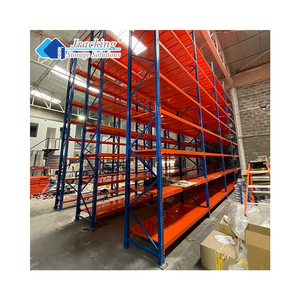
Selective Pallet Systems
Precision-fabricated utilizing certified Q235B high-tensile steel, robotic GMAW welding matrices, and corrosive-resistant finishes for global industrial logistics.
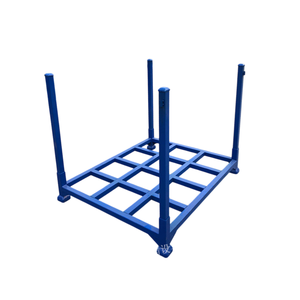
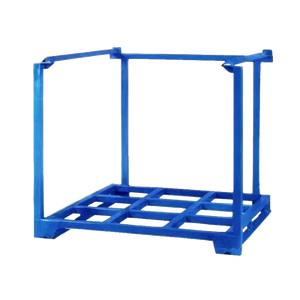
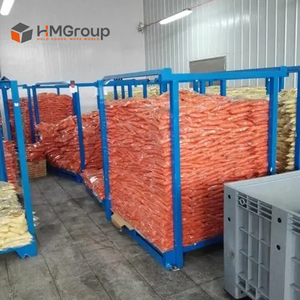
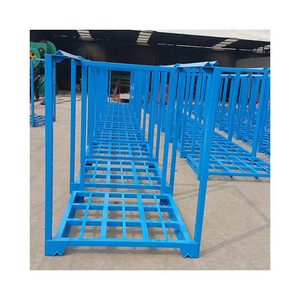
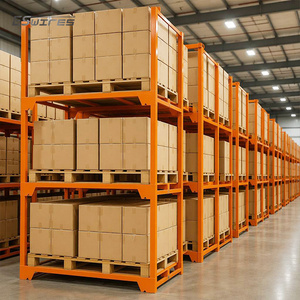
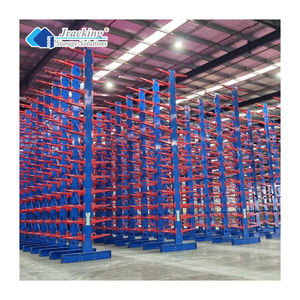
Industrial warehouse operators across cold chain, petrochemical, logistics, and automotive assembly hubs routinely battle footprint inflexibility. While permanent selective racking provides vertical selectivity, it locks structural footprint indefinitely, creating capital liability during seasonal troughs or sudden layout overhauls. Heavy duty nesting racks (frequently specified as Nestainers, palletainers, or post-pallet stacking frames) solve this paradigm through dynamic inverted "angle-iron" or cup-nesting mechanics.
Engineered with proprietary inverted angle iron bases (often 90° inverted structural angles), our custom nestable pallet racks eliminate dirt accumulation while delivering a self-centering structural lock when stacked vertically under heavy load. When loaded, each successive rack’s weight concentrates into the structural columns below, yielding a self-stabilizing pyramid or tiered column layout that effectively counteracts lateral seismic micro-vibrations and forklift contact forces.
Unlike light-gauge commercial shelves made from recycled strip steels, our heavy duty nesting systems incorporate prime Q235B (yield strength ≥ 235 MPa) cold-formed rectangular tubing or hot-rolled structural channels. Welded under automated multi-axis shielding gas cells, the structural joins exhibit verified fatigue endurance exceeding 100,000 load-deflection cycles under maximum certified tonnage.
When unloaded, nesting racks glide into one another at a 45° to 60° angle, allowing up to 4 to 7 empty units to condense into the footprint of just 1. This geometric compression drastically scales return freight economics and opens thousands of square meters of distribution floor when inventory cycles turn over.
Every custom post-pallet nestainer configuration undergoes static and dynamic load simulations. We assess deflection criteria according to FEM 10.2.02 and RMI specifications, maintaining a safety margin factor ≥ 1.5 across column bucking and base weldment interfaces.
Industrial applications in sub-zero freezers (-30°C) or chemical warehouses demand surface resilience. We offer Hot-Dip Galvanizing (HDG according to ASTM A123) and high-adhesion outdoor electrostatic polyester powder coatings that prevent peeling, chalking, and micro-cracking.
Data-driven analysis of how modern distribution centers, automated operations, and ESG mandates are transforming heavy-duty modular racking procurement.
Conventional nestable post pallets historically relied on manual counterbalanced forklifts. The incoming generation of high-payload AMRs (1,500kg to 2,500kg) requires millimeter-accurate fork pockets, optical alignment targets, and tight structural manufacturing tolerances (±1.5mm) on base guide rails. Future-proof procurement now demands nesting racks pre-engineered with AMR pickup sensors and underside optical reflective cavities.
With the rapid boom in temperature-sensitive biologicals, prepared foods, and flash-frozen agricultural produce, cold storage facilities are capital-intensive. Fixed racking installations freeze spatial utility. Portable heavy-duty nesting racks enable 3PL cold-store operators to erect multi-tiered bulk storage lanes within 48 hours without drilling anchor bolts into specialized subfloor insulation or thermal heating matrices.
Supply chain procurement leaders are actively eliminating single-use timber pallets and disposable crating in tier-1 automotive, consumer appliance, and steel component flows. Heavy duty detachable and nestable steel palletainers act as returnable transport packaging (RTP). Achieving a 1:5 return nesting ratio reduces cross-border container empty backhaul emissions by up to 68%, directly aligning with corporate Scope 3 sustainability objectives.
Evaluating the direct operational improvements achieved by shifting from static racks to dynamic nesting modularity.
Standard pallet racks require chemical or mechanical wedge anchors driven into the warehouse slab. Nesting racks are freestanding units that protect expensive high-tolerance concrete slabs, vapor barriers, and under-floor heating wires from damage.
Irregular items like tires, automotive stamping blanks, cylindrical fabric rolls, and bulk agricultural bags deform on standard wooden pallets. Nesting racks enclose the load perimeter, preventing product crushed cartons and stack collapses.
Distribution cross-dock zones experience severe volume spikes during peak trading. Heavy-duty nestable post pallets allow dispatch teams to assemble high-density staging blocks 3 to 4 units high, and nest them away into small corners immediately after container ship-outs.
Combining over 50 years of engineering pedigree, modern automated steel fabrication facilities, and full export compliance to deliver seamless logistics infrastructure.
From prime coiled raw steel roll forming and automated laser cutting to robotic post fixture welding and electrostatic powder application, 100% of production remains in-house under strict ISO 9001:2015 tracking.
All load-bearing calculations, seismic bracing, and safety factors comply with the American RMI ANSI MH16.1, European EN 15512, and AS4084 industrial storage guidelines, complete with third-party testing logs.
Our dedicated packaging engineering team designs specialized bundled dunnage configurations that maximize 40ft High Cube container volumetric utilization, keeping sea-freight overhead per rack unit to an absolute minimum.
International procurement teams benefit from complete bilingual technical drawing packages (AutoCAD, Revit 3D BIM models), mill test certificates (MTC), and direct consultation with seasoned structural engineers.
Clear, technically verified answers regarding structural engineering, material options, lead times, and global shipping logistics.
The primary decision relies on load homogeneity, floor footprint flexibility, and nesting ratios. Standard post pallets use vertical corner posts that are detachable, requiring workers to physically disassemble and bundle posts separately. Nestainers feature fixed, rigid-welded inverted angle bases with integrated structural posts that self-guide into each other at an angle without dismantling. If your operation prioritizes lightning-fast turnaround times for empty unit storage without lost parts, Nestainers offer superior operational efficiency despite a slightly wider nesting footprint than flat-packed post pallets.
Stacking tiers (typically 1+3 or 1+4 units high) are engineered based on three parameters: Base dynamic load capacity, column slenderness ratio (Euler buckling criteria), and floor slab flatness (FF/FL ratings). For a typical 1,500kg unit payload stacked 4 units high, the ground-tier nestainer frame safely carries 4,500kg of superimposed load. Our engineering team supplies complete structural calculations proving that combined vertical stress and minor seismic lateral drift remain within allowable limits dictated by ANSI MH16.1 specifications.
For sub-zero food cold-storage (-20°C to -30°C) with constant moisture transitions, we strongly recommend Hot-Dip Galvanizing (HDG) in accordance with ASTM A123 or ISO 1461. HDG creates a metallurgical zinc-iron alloy barrier that is entirely immune to condensation creep and impact chipping. For indoor, dry-ambient distribution facilities, our electrostatically applied polyester epoxy hybrid powder coating (60–90 microns) offers superior cost-performance and comes in customized high-visibility safety colors (RAL 5015 blue, RAL 2004 orange, or RAL 1023 yellow).
Yes. OEM/ODM customization represents over 65% of our export output. We frequently engineer units for non-standard EUR-pallets (800x1200mm), US standard pallets (40x48 inches), heavy automotive metal skids, steel wire mesh boxes, and cylindrical tire stillages. Custom options include removable wire decking, integrated forklift fork guide sleeves, heavy-duty drop-down side gates for picking ergonomics, and specialized caster assemblies for manual cart towing configurations.
Every export consignment includes a comprehensive Factory Acceptance Test (FAT) dossier: Raw material Mill Test Certificates (MTC checking chemical composition and yield strength), weld penetration inspection reports, powder coat thickness magnetic gauge checks, cross-hatch paint adhesion test certificates, and full 1:1 prototype load deflection testing videos validating compliance with your purchase specifications.