Precision Heavy-Duty Racking & Fabrication Systems
Custom OEM/ODM manufacturing conforming strictly to ANSI MH16.1, FEM 10.2.02, and Thai DPT building codes for advanced warehouse logistics.
1. Structural Dynamics & Kinematics of Double Deep Pallet Racking in Bangkok
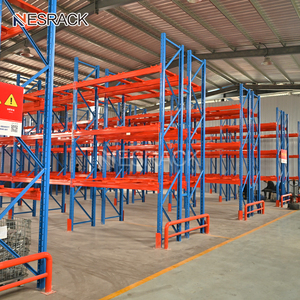
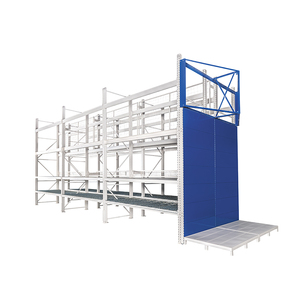
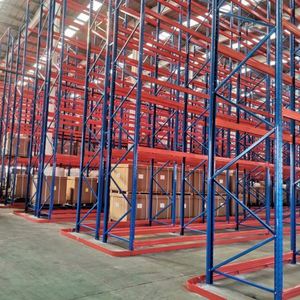
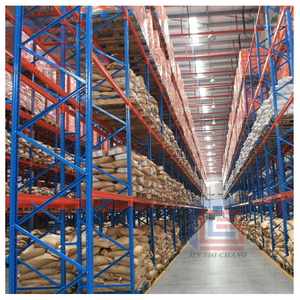
Double Deep Pallet Racking is an engineered storage configuration that positions two pallet loads deep in a single-entry rack or four pallets deep in a back-to-back double-entry rack structure. In high-density industrial corridors such as Samut Prakan, Bang Phli, and the Bang Na-Trat logistics artery, commercial land appraisals have surged by an average of 6.8% annually over the last decade. Consequently, industrial warehouse operators can no longer afford the floor space wastage inherent to standard single-selective pallet racking, where direct aisle access consumes between 60% and 68% of the total building footprint. By eliminating alternate access aisles, Double Deep systems slash aisle allocation down to 35%–42%, instantly increasing cubic capacity utilization by 30% to 38% without requiring the capital-intensive infrastructure demanded by fully automated cranes.
From a structural physics perspective, Double Deep racking introduces eccentric bending moments and cantilever load stresses during the insertion and extraction cycle of the rear pallet. The handling mechanism—typically a pantograph-style scissor-reach truck or dual-depth telescopic fork attachment—exerts forward horizontal reaction forces that amplify deflection across the front horizontal load beams. Our OEM/ODM manufacturing protocols address this specific load path: beam profiles are engineered with deep vertical web sections roll-formed from certified high-tensile structural steel (minimum yield strength $f_y = 355\text{ MPa}$ / Q355B or ASTM A1011 equivalent). Upright columns feature closed tubular structural geometry or cold-formed roll profiles with multi-point interlocking connector tabs, guaranteeing deflection ratios that remain well within the strict $L/200$ deflection limits established by the Rack Manufacturers Institute (RMI MH16.1) and European FEM 10.2.02 standards.
Technical Consideration: Operating a Double Deep system demands coordinated tolerance between the reach mechanism's pantograph mast deflection and the rack's clear opening. In Bangkok installations, our structural calculation sheets incorporate an additional 50 mm clearance allowance on vertical beam pitches and horizontal bay widths to compensate for reach truck mast whip at heights exceeding 8.5 meters.
Closed-Section Tubular Uprights
Unlike standard open C-channels prone to torsional buckling under eccentric reach forces, our SK2000-series tubular frames offer 250% higher torsional resistance against fork truck column impacts.
Heavy-Duty Impact Protection
End-of-aisle structural wrap-around guards and floor-anchored bullnose upright protectors absorb kinetic strikes from 3.5-ton deep-reach forklifts maneuvering in narrow 3.1-meter transfer aisles.
LIFO Inventory Optimization
Double Deep operates on a Last-In, First-Out (LIFO) material flow per lane, making it the mathematically superior, cost-efficient configuration for medium-velocity SKUs storing 2 to 6 pallets per SKU line.
2. System Comparison: Pallet Storage Topologies for Greater Bangkok
Selecting the correct intralogistics storage layout requires balancing floor space density, SKU selectivity, specialized material handling equipment capex, and operational throughput. The matrix below benchmarks Double Deep racking against conventional and automated alternatives utilized in Thailand’s central manufacturing zones.
| Storage Topology | Floor Footprint Utilization | Direct SKU Accessibility | MHE Requirement | Seismic & Soil Sensitivity | Relative Capex Index |
|---|---|---|---|---|---|
| Double Deep Pallet Racking | 65% – 72% | 50% Immediate (2-deep) | Pantograph / Telescopic Reach Truck | Moderate (Engineered Baseplates) | Baseline (1.0x) |
| Standard Selective Racking | 40% – 48% | 100% Immediate | Standard Counterbalance / Reach | Low (Standard Anchor Spacing) | 0.75x |
| Very Narrow Aisle (VNA) | 70% – 76% | 100% Immediate | Turret Truck / Wire Guidance | High (V-flat Floor Super-Tolerance) | 2.2x – 2.8x |
| Drive-In / Drive-Through | 75% – 82% | 15% – 25% (Lane Bound) | Standard Counterbalance inside lane | High (Cantilever Column Bracing) | 1.3x |
| Automated Radio Shuttle | 80% – 88% | Channel Selectivity | Lithium Pallet Shuttle Cart + Forklift | Medium (Leveling Rail Tolerance) | 3.0x – 3.8x |
3. Localization Challenges: Soft Alluvial Clay, Subsidence, and Tropical Humidity
Deploying high-bay steel racking in the Bangkok Metropolitan Region (BMR) demands deep geotechnical awareness. The Chao Phraya River Delta consists of a high-plasticity soft marine clay layer ("Bangkok Clay") extending 12 to 16 meters below the surface. Over decades of groundwater extraction, land subsidence in areas like Samut Prakan, Bang Phli, and Lat Krabang has historically reached rates of 10 to 20 mm per year. When an industrial facility is built on pre-stressed spun concrete driven piles, variations in slab deflection, sub-base settling, and joint rotation can generate structural tilt across tall racking uprights.
In a Double Deep racking installation reaching 10 to 12 meters in height, an angular floor deflection of only 0.5% (1:200) translates into a 60 mm horizontal displacement at the top beam level. This displacement directly threatens reach truck fork insertion into the deep pallet bay. To solve this, our OEM/ODM fabrication engineers design oversized seismic baseplates (typically $250\times 250\times 12\text{ mm}$ or $300\times 300\times 16\text{ mm}$ structural steel plates) equipped with multi-hole anchor patterns and micro-adjustable high-strength non-shrink grout levelling shims. Anchor bolts are selected using Hilti or Fischer chemical capsule adhesive anchors tested for cyclic dynamic shear resistance in cracked concrete, satisfying the mandatory building requirements under the Thailand Department of Public Works and Town & Country Planning (DPT Standard 1301/1302-61: Seismic Design of Buildings).
C5-M Tropical Epoxy Finishes
Bangkok's average relative humidity hovers between 75% and 90%. Our structural components undergo automated shot blasting to Sa 2.5 profile followed by 80–120 micron thermosetting epoxy powder coatings to defeat rust creep.
Post-Tensioned Slab Anchoring
Modern distribution warehouses across Bang Phli utilize jointless post-tensioned (PT) floor slabs. We conduct on-site GPR radar scanning before drilling anchor holes to guarantee zero contact with high-tensile PT tendon ducts.
DPT 1302 Seismic Compliance
Although Bangkok is far from active volcanic zones, soft sedimentary basin soils dramatically amplify distant long-period seismic waves from Myanmar and the Andaman Sea. Our frames feature custom vertical and cross-diagonal K-bracing.
4. Primary Industrial Applications Across Greater Bangkok & the EEC
The unique economic geography of Thailand’s central industrial node connects Greater Bangkok with the Eastern Economic Corridor (EEC) provinces of Chachoengsao, Chonburi, and Rayong. Double Deep pallet racking serves as the backbone across three high-value business sectors operating within this corridor:
1. Automotive Assembly and Tier 1 Component Warehousing (Chonburi & Rayong Corridor): Automotive plants located along the Motorway 7 and Bangna-Trad Highway rely on sequenced batch assembly. Engine blocks, transmission cases, and stamping dies arrive in standardized steel stillages or heavy wooden pallets weighing 1,000 kg to 1,500 kg. Storing components in Double Deep configurations enables tier-suppliers to hold double the buffer stock within identical factory square footage, directly shielding assembly lines from port bottlenecks at Laem Chabang.
2. Temperature-Controlled Cold Storage Logistics (Samut Sakhon & Samut Prakan): Samut Sakhon is the seafood processing capital of ASEAN. Operating sub-zero cold rooms (-18°C to -25°C) incurs massive thermal cooling bills. Cooling an unutilized aisle is pure financial waste. Double Deep racking minimizes the total cubic volume requiring mechanical refrigeration while preserving adequate SKU selectivity for processed seafood exports and poultry storage.
3. E-Commerce and Fast-Moving Consumer Goods (Wang Noi & Bang Phli Mega-Hubs): Serving Bangkok's 11+ million consumer population requires suburban fulfillment hubs positioned along Route 1 (Wang Noi) and Route 34 (Bang Na-Trat). Here, high-turnover fast-moving consumer goods (FMCG) like personal care, dry groceries, and beverages utilize Double Deep racking for deep reserve pallet buffers situated directly above low-level picking tunnels, optimizing replenishment cycle times.
Direct OEM/ODM Manufacturing Infrastructure & Technical Capabilities
As a single-source heavy-duty industrial storage manufacturer, we eliminate intermediary trading companies by delivering direct engineering design, CNC fabrication, robotic welding, and finishing from our ISO 9001/14001 certified production complex.
Robotic Seamless Welding
Automated Panasonic multi-axis welding robots ensure full-penetration robotic welds on connector brackets, eliminating human fatigue variance and guaranteeing cyclic fatigue endurance under extreme warehouse loading.
Custom Continuous Cold Roll-Forming
Equipped with 28-station continuous profile roll-forming mills capable of handling high-grade steel coil up to 4.0 mm thickness with precision hole-punch punching accuracy within ±0.2 mm across a 12-meter upright.
Automated Swiss Gema Coating Lines
Two 320-meter automated continuous powder coating lines featuring 9-stage pre-treatment, iron phosphating, and nano-zirconium passivating ensure superior paint adhesion that withstands ASTM B117 salt spray tests over 500 hours.
5. Market Trends Driving Double Deep Adoption in Thailand (2025–2030)
The Thai industrial property sector is currently undergoing a structural transformation catalyzed by the expansion of the Eastern Economic Corridor (EEC) and the rapid growth of third-party logistics (3PL) providers like Kerry Logistics, Flash Express, DHL Supply Chain Thailand, and WHA Corporation. Analysis of Bangkok's warehousing ecosystem reveals three clear macroeconomic trends accelerating the transition toward Double Deep storage:
Rising Cost of Greenfields vs. Brownfield Maximization: Prime logistics land in Bang Phli (KM 19 to KM 23) has reached historic peak valuations. Investors developing Built-to-Suit (BTS) logistics parks face stringent Land Building Tax obligations. Consequently, supply chain managers are pivoting away from expanding their physical building footprints and instead focusing on maximizing internal volumetric capacity. Double Deep racking provides the optimal return on investment (ROI) inflection point: it achieves up to 80% of the storage density of an automated crane AS/RS system at less than 20% of the initial capital outlay.
Maturity of the Electric Reach Truck Ecosystem: A historical obstacle to Double Deep adoption was the premium cost of specialized reach trucks. Over the past five years, major materials handling equipment manufacturers (such as Toyota Material Handling Thailand, Crown, Linde, and Jungheinrich) have localized their service centers across Bangkok, Chonburi, and Samut Prakan. The availability of high-precision mast-camera guidance systems and auto-height pre-selector controls has drastically minimized fork-pocket alignment errors in deep secondary pallet slots, driving down accidental pallet impact rates by more than 70%.
Frequently Asked Questions for Bangkok & ASEAN Buyers
Direct engineering and commercial answers to the most critical technical challenges encountered during warehouse racking planning and installation in Thailand.
Ready to Maximize Your Facility’s Volumetric Storage Capacity?
Connect with our technical engineering team for complimentary AutoCAD layout planning, load capacity calculations, and custom OEM/ODM factory quotation.