Engineered Inventory
Heavy Duty Storage Systems & Material Handling Equipment
Discover our robust portfolio of industrial racking, automated shuttle arrays, and heavy-material staging platforms engineered for extreme warehouse throughput and challenging operational loads across the Kingdom.
Whitepaper & Engineering Specifications
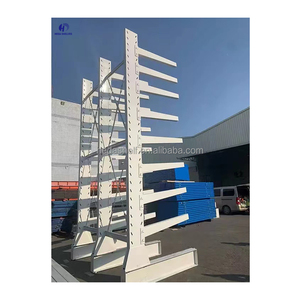
Structural Dynamics of Heavy-Duty Single-Sided Cantilever Racks
An in-depth mechanical and operational breakdown of why hot-rolled structural steel I-beam cantilever configurations remain the gold standard for high-density horizontal material handling in demanding Arabian industrial environments.
In high-capacity material storage, conventional pallet racking configurations are fundamentally unsuited for items whose linear profile defies compartmentalization. Warehouse engineers across the Middle East frequently encounter insurmountable spatial and structural bottlenecks when handling rebar bundles, structural steel beams, extruded aluminum profiles, industrial drill pipes, and oversized engineered timber. Heavy-Duty Single Sided Cantilever Racking delivers an unobstructed horizontal storage facade, transferring sheer mechanical moments directly through structural vertical columns into massive base anchoring assemblies flush-mounted against exterior or interior perimeter walls.
Unlike roll-formed (light-gauge) sheet steel racks that buckle under dynamic side impacts or localized torsional overloads, Steel King heavy-duty single-sided cantilever systems are fabricated entirely from hot-rolled structural steel sections conforming to ASTM A36 and ASTM A992. The single-sided configuration is purpose-engineered to run along warehouse walls, compound enclosures, and perimeter security perimeters, converting otherwise dead peripheral vertical space into high-density storage bays that free up central floor space for high-velocity reach trucks and AGVs.
Hot-Rolled Structural Uprights
Constructed from wide-flange I-beams (W-shapes). The robust Web and Flange geometry offers unmatched resistance to fork truck collisions and torsional buckling, eliminating internal structural fatigue over multi-decade cycles.
Adjustable Bolted Arm Assemblies
Our heavy cantilever arms feature heavy-gauge connector plates secured by high-tensile Grade 8 structural bolts. Vertical arm positions adjust on precise 3-inch centers or 4-inch structural increments without degrading load ratings.
High-Moment Anchored Base Beds
The single-sided footprint depends entirely on counteracting cantilever overturning moments. Base channels are welded or bolted with redundant Hilti or mechanical anchor arrays calculated for seismic ground conditions.
Key Engineering Standard Compliance: Steel King systems are engineered in rigorous conformity with the Rack Manufacturers Institute (RMI) Specification for the Design, Testing and Utilization of Industrial Steel Storage Racks (ANSI MH16.1), alongside strict alignment with the Saudi Building Code (SBC 301 - Structural Loads and SBC 304 - Steel Structures).
Geographic & Sector Fit
Saudi Arabia Market Applications: Infrastructure & Mega-Projects
Meeting the logistical demands of giga-projects across Riyadh, the Eastern Province industrial belts, and Western Province coastal economic hubs.
NEOM, Red Sea & Qiddiya Logistics
Giga-Project Staging & Rebar Yards
Gigantic civil construction yards in Tabuk and Riyadh require rapid-access storage for multi-ton bundles of deformed reinforcing rebar, steel beams, and pre-cast formwork. Single-sided cantilever racks mounted along compound boundary walls allow high-capacity handling without obstructing main transit corridors.
Jubail, Yanbu & Dammam Hubs
Oilfield Tubular Goods (OCTG) & Piping
Petrochemical and drilling supply yards handling high-spec API casing pipes, drill stems, and valves demand non-deflecting, corrosion-resistant rack structures. Our hot-dip galvanized single-sided systems endure corrosive marine air and thermal cycling up to 52°C in Jubail Industrial City.
SPARK & Jeddah Logistics Corridors
Aluminum Profile & Industrial Metal Stock
Architectural aluminum fabrication plants and extrusion stockists require scratch-resistant arm setups, nylon arm pads, and high arm-density configurations to manage delicate architectural profiles, sheet goods, and raw billets with zero deflection and instant crane or forklift accessibility.
Engineering Parameter Comparison: Single-Sided Cantilever
| Structural Parameter | Structural I-Beam Single Sided | Light Roll-Formed Cantilever | Operational Impact in Saudi Facilities |
|---|---|---|---|
| Material Profile | ASTM A992 / A36 Hot-Rolled Wide Flange | Light-gauge cold-rolled sheet steel | Maximum resistance to forklift impacts in busy Saudi staging yards. |
| Load Capacity / Arm | Up to 6,500+ kg (Custom rated) | Typically limited to 400 - 900 kg | Enables vertical consolidation of solid steel bars, pipe packs, and structural beams. |
| Thermal Endurance (Desert Ambient) | High thermal inertia; zero loss of elastic limit | Higher risk of buckling under thermal stress | Withstands extreme summer ambient swings (from 15°C night to 52°C day). |
| Corrosion Protection Options | Hot-Dip Galvanizing (ASTM A123) or Epoxy | Standard interior powder coat only | Essential for coastal facilities in Yanbu, Dammam, and Ras Al Khair. |
| SBC 301 / 304 Seismic Certification | Engineered PE stamping with customized anchor specs | Generic tables with limited local code validation | Ensures smooth approval by municipal engineers and civil defense. |
Macro Market Dynamics
Logistics Modernization Trends Across the Kingdom
How regulatory developments, supply chain nearshoring, and industrial transformation are reshaping raw material storage architectures in Saudi Arabia.
The execution of Saudi Arabia's Vision 2030—spearheaded by the National Industrial Development and Logistics Program (NIDLP)—is sparking an unprecedented expansion of modernized distribution hubs, Special Integrated Logistics Zones (SILZ) at King Khalid International Airport, and port logistics parks at King Abdulaziz Port in Dammam and Jeddah Islamic Port. This structural transformation drives distinct engineering trends for cantilever storage systems:
1. Shift from Floor Stacking to High-Bay Verticality: Historically, heavy raw materials like timber crates and carbon steel piping were floor-stacked in vast open compounds. Skyrocketing industrial land lease rates in King Abdullah Economic City (KAEC) and Riyadh’s industrial clusters make floor-stacking economically unsustainable. Operations are shifting to 6-meter through 10-meter single-sided structural cantilever racks to optimize vertical clear heights while meeting fire clearance regulations.
2. Extreme Environmental Durability Demands: The Kingdom's inland facilities experience severe sand abrasion and high diurnal temperature shifts, while Eastern and Western coastal regions combine extreme relative humidity with marine chlorides. Procurement engineers now routinely bypass standard internal-grade painted racking in favor of dual-coat polyurethane protective systems or heavy hot-dip galvanizing compliant with ISO 1461 / ASTM A123 to eliminate continuous maintenance and premature rack failure.
3. Civil Defense & SBC 301 Structural Rigor: With stricter oversight by the General Directorate of Civil Defense and municipal development authorities, warehouse managers must submit stamped engineering documentation validating floor slab loading, anchor bolt pull-out resistance, and rack behavior under localized seismic events (especially relevant for Western Province fault lines near the Red Sea). Hot-rolled I-beam systems deliver the documented calculations necessary for rapid permitting.
Why Partner With Steel King
Manufacturing Superiority & Engineering Provenance
Founded in 1970, Steel King Industries, Inc. delivers single-source design, fabrication, and structural engineering integrity that safeguards capital investments worldwide.
Single-Source Fabrication
From structural beam shearing and robotic welding to automated powder coating, every structural component is produced in dedicated ISO-certified facilities under strict QA protocols.
RMI Certified Engineering
Full engineering packages including structural finite element analysis (FEA), load plaques, moment diagrams, and anchor design calculated specifically for project coordinates.
Full Lifecycle Protection
Complete integration with our proprietary aisle guards, heavy pipe stops, deck grating, and impact barriers to ensure operators and building structures remain completely secure.
Export Packaging Rigor
Dedicated break-bulk and 40ft high-cube sea-container packing frameworks prevent transport damage, salt-mist oxidation, and bending across international logistics lanes.
Procurement Guidance
Frequently Asked Questions by Saudi Supply Chain Managers
Straightforward answers to the critical engineering, compliance, and logistical considerations involved in procuring single-sided cantilever racking systems.
How do single-sided cantilever systems counteract overturning moments without rear bracing?
Single-sided cantilever columns rely on a rigid, moment-resisting base connection. The structural base channel extends horizontally in the direction of the cantilever arms, creating a mechanical lever arm. Overturning moment ($M = \text{Load} \times \text{Arm Distance}$) is balanced through combined base dead-weight geometry and high-tensile structural anchor bolts drilled into a reinforced concrete slab designed to resist dynamic pull-out forces.
What floor slab specifications are required for heavy-duty single-sided cantilever installations?
For heavy industrial setups handling 3,000 kg to 6,000 kg per arm level, we generally recommend a minimum reinforced concrete slab thickness of 200 mm to 250 mm with a compressive strength of at least 30 MPa to 35 MPa ($f'_c$). Soil sub-base conditions, rebar mesh layout, and perimeter building foundation expansion joints must be reviewed by our structural engineering team before anchoring.
Can Steel King cantilever racks be installed outdoors in hot, coastal Saudi regions like Jubail or Yanbu?
Yes. For outdoor yard operations in high-humidity, marine-chloride zones, we supply columns, arms, bases, and brace frames with a full Hot-Dip Galvanized finish conforming to ASTM A123 / ISO 1461. This yields a metallurgical zinc-alloy coating barrier resistant to UV radiation, salt spray, sand erosion, and high diurnal ambient temperatures up to 55°C.
Do your racking designs comply with the Saudi Building Code (SBC 301 / SBC 304) and Civil Defense fire codes?
Our engineering configurations follow ANSI MH16.1 / RMI standards, which align seamlessly with SBC 304 (Structural Steel) and international seismic building criteria. We furnish certified calculation books, material test reports (MTRs), and anchorage verification that assist local consultants in obtaining prompt Civil Defense and municipal building permit approvals.
What information does our procurement team need to submit to receive an engineered proposal?
To produce an optimized layout and quotation, our structural team requires: (1) Maximum dimensions, weight, and rigidity of the material being stored; (2) Available warehouse clear height and wall boundary offsets; (3) Operating clearance and lift-height limits of your forklifts or sideloaders; (4) Concrete slab thickness and compressive rating; and (5) Indoor or outdoor yard location parameters.