Long-Span Storage
Field-proven automated radio shuttle racking, structural cantilevers, automated robotic palletizers, and high-load industrial shelving engineered to ANSI MH16.1 and FEM 10.2.02 standards.
Years of Heavy-Duty Rack Engineering Excellence
In-House Structural Roll-Forming & Robotic Welding
Export Destination Countries with Direct Technical Support
Structural Failure Record in High-Seismic Installations
An authoritative engineering assessment of deflection tolerances, seismic ductile performance, dynamic loads, and fatigue endurance in high-density automated distribution hubs.
Unlike manual selective racking where a beam deflection ratio of 1/180 is acceptable, high-speed Automated Storage and Retrieval Systems (AS/RS) and automated 4-way radio shuttles demand continuous tolerances strictly tighter than 1/500 under full operational live loads. Our proprietary CNC roll-formed tubular upright profiles ensure that dynamic acceleration shocks from 1,500kg moving pallet shuttles cause zero sensor calibration drift or optical guide rail misalignment.
We utilize certified Q355B and high-strength ASTM A1011 structural steel channels alongside high-grade pre-galvanized coils. In cold chain logistics operating at sub-zero temperatures down to -30°C, ordinary carbon steel suffers brittle transition failure. Our metallurgy incorporates controlled manganese and micro-alloyed niobium to guarantee Charpy V-notch impact toughness exceeding 27 Joules at -40°C, preventing brittle fracture under sudden operational shock loads.
Every high-bay automated installation undergoes comprehensive Finite Element Analysis (FEA) compliant with Eurocode 3 (EN 1993-1-3), FEM 10.2.08, and ANSI/RMI MH16.1 specifications. By engineering proprietary rotational column base connections with controlled post-elastic plastic energy dissipation, our high-density racking buildings safely absorb multi-directional seismic ground accelerations without catastrophic structural buckling or localized frame collapse.
| Racking Architecture | Volumetric Space Utilization | Access Selectivity | Dynamic Throughput Velocity | Best Application Profile |
|---|---|---|---|---|
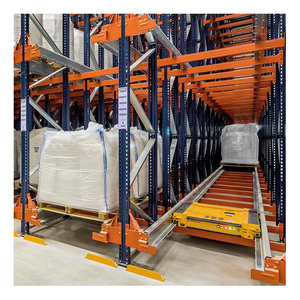
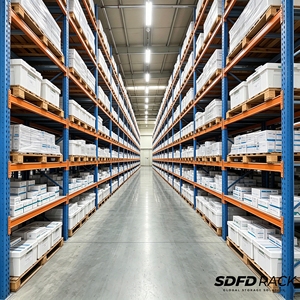
| Automated Radio Shuttle Racking | Ultra-High (85% - 90%) | Lane-Based FIFO / LIFO | Fast (Remote/PLC Directed) | FMCG, Cold Storage, Food Processing, High-Volume Batches |
| Rack-Supported AS/RS Buildings | Maximum (>92%, up to 40m) | Automated Single Pallet | Continuous High Cycle Speed | Mega E-Commerce Hubs, Strategic Reserve, 24/7 Dark Warehouses |
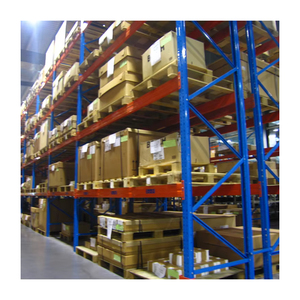
| SK3000 Structural Bolted Racking | Moderate (50% - 65%) | 100% Immediate | Forklift Dependent | Heavy Machinery Parts, Harsh Impact Staging, Raw Coil Depots |
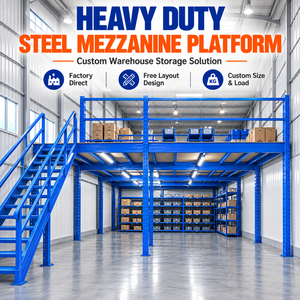
| Heavy Duty Mezzanine Storage Floors | Dual-Level Floor Gain (200%) | 100% Manual / Cart Access | Moderate Picking Velocity | Apparel, Spare Parts Sortation, Mixed-SKU Distribution |
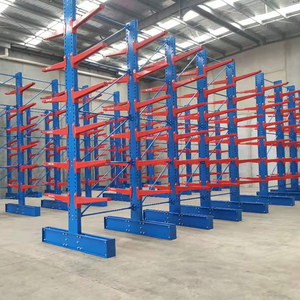
| Adjustable Structural Cantilever | Open Clear-Span Overhead | Continuous Open Face | Specialized Side-Loader | Structural Steel Beams, Extruded PVC Pipes, Engineered Timber |
Strategic evaluation of capital allocation, life-cycle costs, sustainability compliance, and robotic integration driving automated logistics investments over the next decade.
The global logistics sector is rapidly transitioning from traditional rigid stacker cranes to flexible, decentralized 4-way multi-directional pallet shuttles combined with Autonomous Mobile Robots (AMRs). Enterprise procurement contracts increasingly stipulate dynamic shuttle guide rails with continuous power rail integration, optical position tracking tracks, and multi-tier floor transfer elevators. Future-proof rack design requires structural geometry that accommodates hybrid human-robot navigation corridors.
Driven by stringent industrial safety governance (OSHA and European EN 15635), forward-thinking procurement teams are moving toward "Intelligent Racking". This includes integrating IoT strain gauges, 3-axis MEMS accelerometers, and wireless impact sensor tags directly onto critical upright bases. These arrays detect micro-deflections, localized structural deformations from accidental forklift impacts, and overload distribution imbalances, alerting plant engineers prior to crack propagation or frame fatigue.
Supply chain sustainability mandates (Scope 3 GHG reductions and EU Carbon Border Adjustment Mechanism compliance) are fundamentally altering vendor qualification matrices. International buyers actively prioritize manufacturers leveraging Electric Arc Furnace (EAF) low-carbon steel, energy-efficient closed-loop hot-dip galvanizing lines, and zero-VOC heavy-duty electrostatic powder coatings that deliver exceptional corrosion longevity without environmental degradation.
Eliminating third-party subcontracting risk through vertically integrated manufacturing, certified structural analysis, and global project logistics coordination.
Our state-of-the-art manufacturing plants house high-speed automated roll-forming lines with multi-station punching, robotic 6-axis laser cutting, and automated continuous seam-welding cells. Every upright, structural horizontal brace, pallet runner, and cantilever arm is produced under strict ISO 9001, ISO 14001, and ISO 45001 operational frameworks, ensuring that every hole pitch, interlock slot, and weld seam matches structural blueprints within 0.2mm tolerance.
Cross-border infrastructure projects frequently stall due to inadequate architectural approvals. We provide complete, PE-stamped structural calculation packages, detailed anchor pull-out test reports, 3D Building Information Modeling (BIM) structural files (Revit/IFC), and step-by-step CAD installation guides. Our documentation simplifies local regulatory permitting across municipal building authorities worldwide.
Ocean container transport exposes steel components to severe humidity, saline condensation, and dynamic racking motion. We utilize heavy-duty custom steel frame pallets, specialized multi-layer vapor corrosion inhibitor (VCI) shrink wrap, corner shock-absorbers, and sequenced bundle strapping. This ensures zero thread corrosion, zero beam impact deformation, and optimized un-stuffing efficiency at destination container terminals.
Direct technical clarity on load certification, floor slab specifications, cold-chain corrosion mitigation, and lead-time guarantees for global logistics executives.
Engineering an automated or high-bay system requires concrete slab thickness (typically 200mm to 300mm), compressive strength (f'c rating, typically ≥30 MPa), rebar reinforcement layout, and joint load transfer data. In addition, floor flatness and levelness specifications (FF/FL numbers per ASTM E1155 or DIN 18202 Table 3 Group 4) must be established to ensure high-speed shuttle trucks or narrow-aisle cranes operate without dynamic tipping risks.
While cold roll-formed closed tubular uprights (such as SK2000 style) offer superior torsional resistance and lower upfront steel cost for general warehousing, structural hot-rolled channel racks (SK3000 style) deliver exceptional impact toughness against forklift abuse. In high-velocity food distribution and cold storage environments, structural steel reduces maintenance calls, downtime, and column replacement frequency by over 70%, drastically lowering lifetime operational expenditure.
For deep-freeze environments (-25°C to -30°C) with persistent condensation risk, we recommend continuous hot-dip galvanizing (HDG) conforming to ISO 1461 / ASTM A123, providing a zinc layer thickness of 65-85 microns. For ambient or temperature-controlled facilities, our multi-stage zinc phosphate pre-treatment followed by high-durability thermosetting polyester powder coating provides up to 1,000 hours of continuous salt spray test resistance (ASTM B117).
Yes. Our automated radio shuttle and AS/RS platforms support standard industrial PLC protocols (Siemens, Rockwell) with bi-directional RESTful APIs, OPC-UA, and Modbus TCP/IP. This enables real-time pallet location tracking, dynamic inventory counting, automated FIFO/LIFO execution, and battery management data to synchronize directly with enterprise systems including SAP, Oracle NetSuite, and specialized Warehouse Management Systems (WMS).
Our engineering division routinely designs and validates systems to United States ANSI/RMI MH16.1 and IBC (International Building Code), European EN 15512 and FEM 10.2.02, as well as Australian AS 4084 standards. Every project proposal is accompanied by site-specific seismic acceleration calculations (Ss, S1 parameters), dynamic spectral response analysis, and certified anchor bolt shear-moment calculations.
Connect directly with our senior racking structural engineers. We provide comprehensive warehouse space utilization layouts, 3D CAD simulations, and detailed structural pricing quotations within 24 hours.