ANSI MH16.1 & RMI Certified Automated Intralogistics Whitepaper Direct Factory Engineering

Top 10 Heavy Duty Four Way Shuttle Racking Factories & Suppliers

An industrial engineering evaluation of 3D pallet shuttle automated warehouses, dynamic rail tolerances, cold-chain deployment, and total lifecycle ROI benchmarks for high-throughput supply chain leaders.

Get Catalog
55+
Years Engineering
Structural & AS/RS design reliability since 1970
1,500kg
Payload Capacity
Heavy-duty continuous rail payload testing
-30°C
Cold-Chain Grade
High-torque LiFePO4 battery cold endurance
99.8%
System Availability
WCS dynamic task route switching redundancy
Enterprise Engineered Solutions

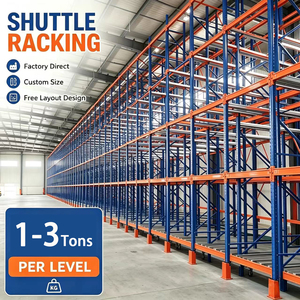
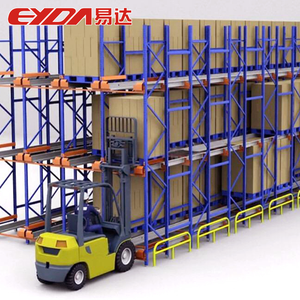
High Density Heavy Duty Four-Way Shuttle & Pallet AS/RS Portfolio

Compare our engineered product line for autonomous pallets, ultra-dense channel storage, and deep-freeze logistics designed to eliminate forklift congestion.

Technical Architecture White Paper

Two-Way vs. Four-Way Pallet Shuttle Racking: The Engineering Paradigm Shift

Discover why Fortune 500 distribution operations are transitioning from conventional deep-lane shuttles to 3D omnidirectional 4-way robotic matrix structures.

Kinematic Freedom & Route Redundancy

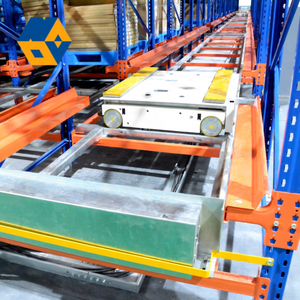
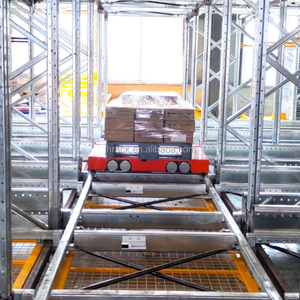
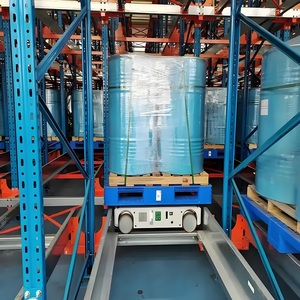
Traditional 2-way radio shuttles are strictly trapped in single physical lanes; shifting aisles requires manual forklift relocation. A true 4-way shuttle (four-way runner) executes automated 90-degree wheel steering transformations directly on precision-milled junction rails.

This allows self-governing shuttles to bypass bottlenecked lanes, navigate around disabled vehicles, and dynamically distribute load pressure across all longitudinal and cross-aisle directions without human intervention.

Decoupling Vertical & Horizontal Kinematics

Unlike crane-dependent Stacker Crane AS/RS systems where mechanical failure disables an entire aisle from floor to ceiling, a four-way shuttle system completely separates horizontal movement from vertical hoisting.

If a shuttle vehicle requires maintenance, it is simply routed out to a service bay while remaining shuttles seamlessly absorb the load. Facilities can dynamically increase shuttle fleet counts to conquer peak holiday volumes without adding racking steel.

Structural Steel Deflection & Rail Tolerances

Four-way shuttle engineering imposes stringent deflection thresholds far tighter than conventional selective racking. Under ANSI MH16.1 specifications, allowable beam deflection is typically L/180; however, robotic four-way runner guide rails require deflection limits exceeding L/400 to L/600.

Our heavy-duty Q355B high-tensile structural profiles and cold-formed continuous shuttle tracks prevent sensor misalignment, wheel slip, and autonomous docking stall under maximum 1,500kg dynamic pallet loads.

Supplier Selection Framework

Top 10 Global Heavy Duty Shuttle Racking Manufacturers & OEM Landscape

An unbiased comparative matrix reviewing the world's leading industrial rack manufacturers and 4-way intralogistics system integrators.

Manufacturer / Ecosystem Tier Structural Rigidity & Steel Tech Shuttle Fleet Scalability Cold-Chain Tolerance WMS / WCS Open API Integration Procurement Profile
Steel King Industries, Inc. (USA) SK3000 Hot-Rolled Channel & SK2000 Closed Tube Modular 2D/3D Integration with Open Fleet Architecture Rated down to -30°C Freezer Application Certified Native OPC-UA / REST API Middleware Heavy-Duty Benchmark
Mecalux (Spain) Standard European Cold-Formed Profiles High Vertical Integration with Proprietary Software Standard Cold Store (-25°C) Easy WMS Proprietary Architecture Full Turnkey / Closed
SSI Schaefer (Germany) High Precision European Structural Sections Customized Orbiter & High-Bay 3D Shuttles Engineered Deep-Freeze Environments WAMAS Integrated Logistics Suite Premium Enterprise
Dematic / KION Group (Germany/USA) Structural Bolted Framework High-Throughput Multishuttle & Pallet Systems Standard Ambient to Low Temp Dematic iQ Platform Large Mega-Hubs
Daifuku (Japan) Japanese Standard Cold-Formed High Strength Steel High Reliability Shuttle and Rail Guided Vehicles Proven Food Cold Chain Facilities Proprietary Japanese Industrial Controllers High CapEx Greenfield
Vanderlande (Toyota Ind.) Standard Welded / Tubular Modular Steel Fast Parcel and Pallet Matrix Systems Ambient / Regulated Grocery Vibe Warehouse Control Suite Airport & High Flow 3PL
Stow Group / Stow Robotics (Belgium) Profile 140 Structural Pallet Configurations e.stow / Atlas 2-Way & 4-Way Shuttles Certified to -25°C Stow WCS Orchestration European Standard
Interlake Mecalux (North America) Roll-Formed Step Beam & Slotted Columns Semi-Automated Pallet Shuttle Carts Standard Cold Storage Mecalux WMS Mid-Market Distribution
Bito Lagertechnik (Germany) Light to Medium Structural Galvanized Beams Compact Shuttle & Flow Rack Systems Ambient Food & Beverage Hubs Open Bus Integrator Ready Select Distribution
NOVA Storage / Asian Direct OEMs Q235B / Q355B High Capacity Roll-Formed & Welded Autonomous 4-Way Intelligent Runner Units -30°C Insulated LiFePO4 Systems Open Protocol PLC & Fast API Interfaces Optimal Value / Agility

*Data based on verified factory engineering specs, international standard filings, and warehouse automation benchmark databases.

Strategic Horizon 2026 - 2030

Future Procurement Trends in 4-Way Automated Shuttle Racking

Key market transitions every VP of Supply Chain and Industrial Facility Designer must evaluate before signing project contracts.

LiFePO4 Supercap Hybrid Power Units

Traditional lead-acid and standard lithium chemistry batteries experience catastrophic degradation in sub-zero freezer hubs. Future procurement is shifting toward hybrid supercapacitor + Lithium Iron Phosphate (LiFePO4) power cells.

These units support 3-minute rapid opportunity charging directly at the vertical lifter junction, eliminating battery swap downtime and delivering 24/7 continuous autonomous material handling.

AI Dynamic Heat-Mapping & Predictive Slotting

Modern warehouse controllers (WCS) no longer treat pallet locations as static slots. In 2026 and beyond, integrated neural algorithms continuously calculate SKU velocity and automatically command 4-way shuttles during off-peak hours to reshuffle high-turnover cargo closer to the dispatch lifters.

This automated defragmentation shortens out-of-storage cycle times by 32% during morning dispatch peaks.

Rack-Supported High-Bay Architecture

With industrial land costs and construction inflation skyrocketing, logistics enterprises are abandoning traditional structural concrete shells in favor of Rack-Supported Buildings (clad-rack structures).

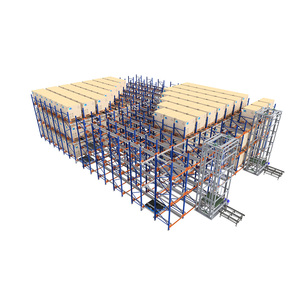
The four-way shuttle racking uprights serve simultaneously as the building's load-bearing structural framework holding wall claddings and insulated roof systems—drastically decreasing construction timelines and capturing up to 40% greater cubic utilization.

Enterprise Heritage & Quality

Built Strong. Engineered Right. Backed by 55+ Years of Steel Mastery.

When you invest in a multi-million-dollar four-way autonomous AS/RS facility, structural integrity cannot be an afterthought. Our complete manufacturing ecosystem ensures absolute single-source accountability from raw steel coil to on-site automation validation.

  • In-House Heavy Duty Fabrication & Engineering

    100% controlled domestic design and manufacturing. Certified to strict RMI (Rack Manufacturers Institute) and ANSI MH16.1 specifications with custom seismic and dynamic floor slab finite element analysis (FEA).

  • Hot-Rolled Structural & Heavy Tubular Columns

    Option for SK3000 structural steel channels or SK2000 closed tubular upright columns offering 250% higher torsional strength and impact resistance against operational equipment collisions.

  • Precision Dynamic Shuttle Rail Tolerances

    High-precision galvanized guide rails with CNC punched indexing points ensuring micro-level alignment (±1.5mm) across 40-meter tall automated structures to eliminate shuttle stall.

  • Single-Source System Lifecycle Warranty

    Complete project support: from layout drawings, permit documentation, and anchor testing to global distributor network installation and certified maintenance support.

Rigorous Factory Engineering Benchmarks

Column Impact Resistance
Hot-rolled vs. Standard Roll-form
Torsional Deflection Rigidity
SK2000 Closed Tubular Upright Profile
Sub-Zero Freezer Longevity
-30°C Continuous Cold Operation
WCS Hardware Interoperability
Open Bus / Multi-Vendor Compatibility

"Structural precision is the core foundation of autonomous robotics. A 3mm rail deflection can halt an entire automated distribution facility. We engineer the structural steel so your shuttles never stop moving."

Enterprise Procurement Intelligence

Frequently Asked Questions on Heavy Duty Four-Way Shuttle Systems

Direct technical clarity on fire safety codes, slab loading requirements, battery lifecycle, and return-on-investment timelines.

Due to the multi-level stacking density and concentrated post loads of 4-way AS/RS structures (often exceeding 8 to 15 tons per post), concrete slabs must be engineered with high compressive strength (typically 30 to 40 MPa / 4500 PSI minimum). Slab flatness must conform to DIN 18202 or ACI F-min 75 to 100 specifications to ensure that vertical lifters, rail junctions, and high-speed robotic runner wheels maintain continuous planar contact without vibrational degradation.
Because heavy-duty shuttle systems create ultra-dense storage cubes without conventional forklift aisles, standard ceiling-only sprinklers cannot adequately penetrate deep layers. In accordance with NFPA 13 and local fire building codes, our engineering designs incorporate designated longitudinal and transverse flue spaces (typically 6 inches) alongside in-rack sprinkler piping networks positioned at targeted level tiers. Shuttle rails and beam profiles feature pre-engineered bracket punchings to accommodate water pipes without obstructing robot travel planes.
Across standard 5,000 to 25,000 pallet locations, average payback ranges between 2.2 to 3.8 years depending on regional labor costs and operating temperatures. In cold storage freezers (-25°C), ROI accelerates dramatically because consolidating footprint saves up to 40% in refrigeration thermal dissipation while eliminating forklift battery chill loss and reducing high turnover human labor inside hazardous environments.
Yes, but it requires dual-profile support rail channels or slave pallets. If planned during initial project engineering, our bidirectional rail channels are fabricated with step-notch geometry to support both standard US 48"x40" GMA pallets and European 1200x800mm pallets. Dynamic optical sensors on the shuttle car automatically detect pallet under-clearance and overhang, adjusting carriage lift centers before high-speed transverse acceleration.
Our autonomous architecture includes built-in redundant recovery mechanisms: 1) Secondary shuttle rescue pushing/towing routines via WCS command; 2) Manual maintenance platform tethering with wireless remote override; and 3) A dedicated mechanical wheel clutch release allowing technicians to pull the unit to a service hatch without disassembling racking steel.
Engineering Consultation & Custom Layouts

Ready to Maximize Your Cubic Storage Density?

Send us your warehouse CAD floor plan, pallet load specifications, and target throughput cycles. Our senior intralogistics structural engineers will configure a 3D shuttle simulation and custom budget estimate within 48 hours.