Engineered Equipment Catalog
High-Performance Industrial Storage Solutions
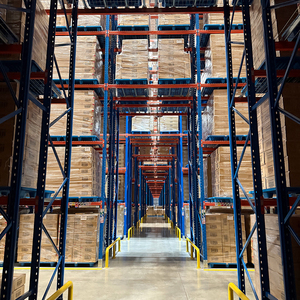
Explore our heavy-duty warehouse racking modules, pallet flow systems, and automated shuttle interfaces tested for rigorous continuous loading.
50+
Years Structural Heritage
1,500 kg
Rated Payload / Carrier
1.2 m/s
Shuttle Transit Velocity
-30°C
Sub-Zero Operation Rating
Whitepaper & Technical Analysis
High-Density Radio Shuttle Systems: Architectural Mechanics
A technical evaluation of high-density semi-automated racking architecture, dynamic rail tolerances, and material yield specifications.
Dynamic Rail & Upright Integrity
Unlike static selective racking or drive-in cantilever arms, radio shuttle racking relies on continuous-profile cold-formed or hot-rolled rails that serve as both pallet load-bearing ledges and precision tracks for the carrier cart.
- High-yield structural grade steel (minimum Q355B / S355JR equivalent).
- Tolerance thresholds limited to ±1.5 mm across run-length spans to prevent derailment.
- Integrated optical reflector mounts and mechanical end-stop safety buffers.
Carrier Automation & Power Density
The radio shuttle cart incorporates brushless servo-driven DC motors paired with heavy-duty lithium iron phosphate (LiFePO4) or supercapacitor power cells engineered for thermal resilience.
- Sub-zero thermal package ensuring operations down to -30°C without condensation failure.
- Real-time laser obstacle detection and pallet centering sensors.
- Industrial Wi-Fi / 433 MHz RF communication linking directly with WMS/WCS.
CE Machinery Compliance Framework
CE certification for shuttle systems mandates rigorous conformity with both structural racking standards (EN 15512, EN 15620) and automated vehicle safety (EN 15095 & Machinery Directive 2006/42/EC).
- Electromagnetic Compatibility (EMC Directive 2014/30/EU) compliance.
- Functional safety circuits with redundant emergency braking systems.
- Seismic verification modeling aligned with Eurocode 8 seismic zone standards.
Market Dynamics & Future Outlook
Future Procurement Trends in High-Density Automation
Macro supply chain realities, skyrocketing warehouse real estate costs, and green energy mandates are altering industrial pallet storage procurement.
| Evaluation Parameter | Traditional Drive-In Racking | Pallet Flow (Gravity) Rack | CE Heavy Duty Radio Shuttle System | AS/RS Stacker Crane High-Bay |
|---|---|---|---|---|
| Volumetric Utilization | 60% – 65% | 70% – 75% | 80% – 85% (Optimal) | 85% – 90% |
| Forklift Impact Risk | Extremely High (trucks drive inside bays) | Low (dock interface only) | Near Zero (isolated to aisle face) | Zero (fully enclosed) |
| Pallet Cycle Throughput | Slow (15–20 pallets/hr per mast) | Moderate (dependent on pitch & brakes) | High (up to 45 pallets/hr per shuttle) | Very High (60+ pallets/hr) |
| Inventory Strategy | Strictly LIFO | Strictly FIFO | Configurable FIFO / LIFO on Demand | Dynamic Software Optimized |
| Initial Capital Outlay (CapEx) | Low ($) | Moderate ($$) | Moderate Balanced ($$$) | Extremely High ($$$$$) |
| Installation Lead Time | 4 – 8 Weeks | 6 – 10 Weeks | 8 – 14 Weeks | 9 – 18 Months |
Trend 1: 4D Multi-Directional Shuttles
The industry is moving rapidly from standard 2-way linear shuttles to 4-directional cross-aisle autonomous carriers. By traversing lateral transfer tracks and vertical continuous elevators, 4D shuttles achieve matrix automated storage without dedicated stacker cranes.
Trend 2: Cold-Chain Carbon Efficiency
With refrigerated space costing up to 5x standard ambient storage, food and pharmaceutical 3PLs are standardizing on shuttle systems to eliminate access aisles. Reducing cubic air volume cuts cooling energy consumption by up to 35% annually.
Trend 3: Predictive Maintenance IoT
Next-generation shuttle carts feature onboard vibration sensors, thermal monitoring of motor bearings, and cycle telemetry. Fault conditions are signaled before mechanical line stoppage occurs, avoiding expensive inventory stranding.
Engineering Authority
Single-Source Manufacturing & Structural Leadership
Combining heavy-duty hot-rolled and cold-formed steel manufacturing expertise with international turnkey project management.
Structural & Tubular Roll-Forming
Complete control over cold-formed tubular profiles (SK2000 standard) and hot-rolled structural steel channels (SK3000 standard) ensures optimal impact resistance under heavy forklift traffic.
RMI & Eurocode Compliance
Structural calculations executed strictly to RMI ANSI MH16.1, EN 15512, and site-specific seismic parameters, providing stamped structural calculations for permitting and inspection approval.
Turnkey System Integration
From aisle guide rails and shuttle charging docks to software handshakes with Tier-1 WMS software, we deliver end-to-end material handling integration without communication gaps.
Export Packaging & Global Support
Reinforced maritime bundling, anti-corrosion barrier packaging, detailed installation manuals, and authorized global field commissioning crews protect project timelines internationally.
Procurement FAQ
Frequently Asked Engineering & Sourcing Questions
Detailed technical answers addressing floor slab tolerances, cycle capacities, battery endurance, and safety validation.
What warehouse floor slab criteria are required for radio shuttle installations?
Unlike standard selective racks where point loads are distributed across wider aisles, radio shuttle racking concentrates substantial dynamic loads across tight column matrices. The concrete slab should typically meet a minimum compressive strength of 25–30 MPa (3,500–4,000 PSI) with floor flatness conforming to DIN 18202 Table 3 (or ASTM E1155 FF/FL standards).
Excessive slab deflection or joint settling can distort the shuttle running rails. Structural shimming and heavy-duty steel baseplates with specialized mechanical or chemical expansion anchors must be calculated against site-specific seismic and seismic overturning forces.
How does battery duty cycle management work in high-throughput 24/7 cold storage?
For multi-shift and continuous operations, shuttle systems employ rapid-swap lithium iron phosphate (LiFePO4) battery packs. Under normal ambient conditions (15°C to 25°C), a battery pack provides 8 to 10 hours of continuous transit on a 2 to 3-hour recharge cycle.
In sub-zero cold rooms (-25°C to -30°C), battery capacity suffers derating. To maintain continuous productivity, our cold-chain shuttle units are equipped with internal thermal heating blankets for battery cells, and we typically specify a 3:1 or 2:1 battery-to-cart ratio along with heated fast-charging docking bays located immediately outside the freezer boundary.
What is the difference between CE-certified shuttles and non-certified alternatives?
A CE-certified radio shuttle system carries verifiable compliance under the European Machinery Directive (2006/42/EC), Low Voltage Directive (2014/35/EU), and EMC Directive (2014/30/EU). Non-certified alternatives often cut costs on circuit redundancies and sensor ratings.
CE-compliant shuttles feature dual-channel Category 3 / PL d safety circuits, mechanical safety end-stops capable of arresting full load at maximum speed, laser-based distance measurement systems (Class 1 eye-safe), and third-party laboratory verification of emergency fail-safe braking.
Can a single radio shuttle handle mixed pallet types (e.g., Euro vs. Industrial GMA)?
Yes, provided the shuttle cart and rail profile are engineered for multi-pallet handling. While standard Euro pallets (800 x 1200 mm) and standard industrial/GMA pallets (1000 x 1200 mm or 40 x 48 inches) have different base board designs, dual-direction sensor arrays and custom widened shuttle guide rails accommodate varying bottom board entry profiles.
Quality pallet integrity remains crucial: damaged or hanging bottom deck boards can trigger optical safety stops or jam inside the rail channel. Pallet inspection stations at the staging dock are recommended before induction.
What engineering documentation is required before issuing a quotation?
To engineer an accurate radio shuttle solution, suppliers need: (1) Architectural CAD layout detailing building clear height, column grids, and obstacles; (2) Pallet specifications including overall dimensions, overhang, and gross weight ranges; (3) Throughput demands in pallets/hour for storage and retrieval; (4) Operating environmental temperature profiles; and (5) Local regulatory parameters such as floor slab thickness and geographic seismic zone ratings.
Ready to Optimize Your Storage Footprint?
Consult directly with our rack design team. We offer complimentary structural layout modeling, slotting simulations, and clear technical project documentation.