Warehouse space is costly, and every aisle affects storage capacity. Heavy Duty Drive In Racking can increase pallet density by allowing forklifts to enter storage lanes. It is often considered for large quantities of similar products, where access to every individual pallet is not essential. The trade-off is real: fewer access aisles can mean less selective retrieval.
The 2024 MHI Annual Industry Report, produced with Deloitte, found that 55% of surveyed supply chain professionals planned to increase investment in supply chain technology. That figure does not measure racking performance, but it reflects pressure to improve warehouse operations. Storage design is part of that effort. In a drive-in system, pallets are typically stored on rails, with loading and retrieval managed from the lane entrance. Product dimensions, pallet condition, forklift compatibility, and inventory rotation all matter.
The right choice depends on the operation. High-density storage can help when product runs are deep and turnover patterns are predictable. It can be less suitable when teams need rapid access to many different SKUs. A site assessment should consider clear height, floor condition, load specifications, and safe forklift clearances. Even a well-designed layout can disappoint if daily handling practices do not match it. That part is easy to underestimate.
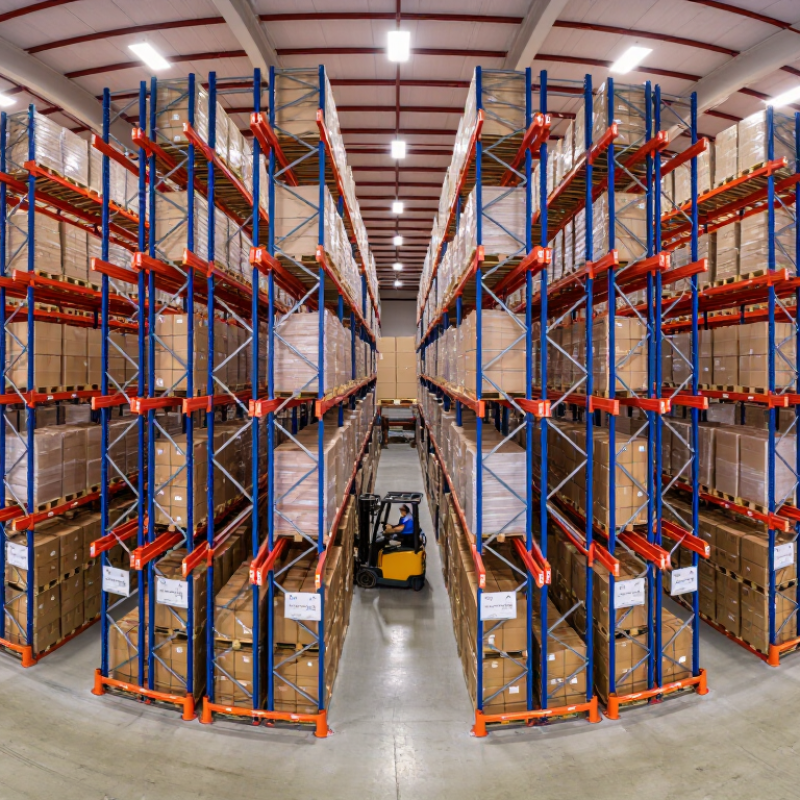
Heavy-duty drive-in racking stores pallets in deep lanes, reducing the number of access aisles. Each lane has upright frames and horizontal support rails. A forklift enters the lane and places pallets from the back toward the entrance. To retrieve stock, the operator removes the pallet nearest the aisle first. This creates a last-in, first-out flow.
A narrow working corridor. The design suits batches of similar products, but not every inventory profile. Forklift dimensions, pallet condition, floor capacity, and load weights all affect safe lane design. The MHI 2024 Annual Industry Report found that 55% of surveyed supply-chain professionals planned to increase investment in supply-chain technology and innovation. That figure is not a rack-performance measure, but it reflects the pressure to use warehouse space carefully. Denser storage can help, yet it also reduces direct access to individual pallets. A misplaced pallet or damaged rail can disrupt a whole lane. It is worth checking clearances and load ratings on site; drawings alone can miss awkward details.
In deep-lane storage, a forklift enters the rack channel to place or retrieve pallets. This arrangement can increase storage density, but access follows a last-in, first-out pattern: the newest pallet placed in a lane is usually the first one retrieved. That matters when stock needs strict date-based rotation. A warehouse handling dated goods may need separate lanes, clear labels, and disciplined replenishment to avoid older pallets becoming stranded behind newer ones.
The trade-off is easy to underestimate. MHI’s 2024 Annual Industry Report identified labor and talent shortages as a leading supply-chain challenge for surveyed organizations. Drive-in racking does not remove forklift skill requirements; operators must enter lanes carefully and handle loads without striking rails. A practical layout should match lane depth to inventory turnover, pallet consistency, and forklift access. For example, storing several pallets of the same product in one lane makes LIFO easier to manage than mixing products with different dispatch dates. Less travel, potentially. More discipline, too.
LIFO can work well for stable, high-volume stock where the newest pallet is acceptable for the next order. It is less suitable when every pallet must be picked in age order. Review actual order patterns before choosing lane depth, and test the replenishment sequence with warehouse staff. A neat drawing does not always predict daily behavior. That deserves a second look.
Heavy Duty Drive-In Racking: More Pallet Positions in Less Space
Drive-in racking can provide up to 75% more pallet positions than some selective rack layouts, depending on the building and storage plan. It achieves this by letting forklifts enter deep lanes, reducing the number of aisles needed. More of the floor can then hold pallets instead of travel space. The exact gain is not guaranteed; pallet dimensions, clearances, and column locations all affect capacity.
This layout works best when many pallets share the same product and can be stored in batches. A forklift loads and retrieves pallets from the same lane opening, so the last pallet placed is usually the first one removed. That suits products with flexible rotation, but not every operation. Fewer aisles also mean less direct access to individual pallets. It is a trade-off that can be easy to underestimate.
Tips: Measure actual pallet loads, including overhang, before setting lane depth. Check forklift turning clearance and rack protection needs. Keep lane assignments clear, and review stock rotation requirements. A simple capacity sketch helps, but test the proposed layout against daily picking patterns too. Walk the route. A few minutes of checking can reveal a bottleneck the drawing missed.
Heavy-duty drive-in racking is designed around the loads it must carry, not a generic “pallet weight.” Record each unit load’s verified weight, pallet dimensions, overhang, and load distribution. Note whether products shift or arrive with uneven bases. Small details matter. A 1,000-kilogram pallet with an off-center load can stress rails differently from a balanced one.
Rack designers also need the forklift’s exact make and model, overall width, mast height, turning radius, and required operating aisle. Check the truck data plate for rated capacity at the intended lift height and load center. OSHA’s powered-industrial-truck standard, 29 CFR 1910.178, requires capacity and load-center information on the truck nameplate; attachments can change capacity. Measure the real approach path, too. A truck that fits an aisle on paper may scrape upright guards during a tight entry.
Provide these details to a qualified rack designer, along with bay depth, beam or rail elevations, floor condition, and local seismic requirements. The Rack Manufacturers Institute’s ANSI MH16.1 specification sets structural design criteria for steel storage racks, including applicable load combinations. It is a design reference, not a substitute for site measurements. One common weak point is outdated forklift information. It happens. Recheck truck data and pallet weights after equipment or product changes, then have the rack capacity confirmed before loading.
| Design data | Example input | How it affects rack design and capacity |
|---|---|---|
| Unit load mass | 1,000 kg per loaded pallet | Sets the payload carried at each storage position. Beam, upright, rail, bracing, and base reactions must be checked against the actual load and rack configuration. |
| Pallet footprint | 1,200 mm deep × 1,000 mm wide | Determines channel width, rail spacing, clearances, and the required forklift entry opening. The pallet must be supported as specified by the rack designer. |
| Loaded pallet height | 1,400 mm, including pallet | Controls vertical pitch and the number of storage levels. Allow additional clearance for lifting, placement, load variation, and building or sprinkler requirements. |
| Load stability and overhang | Uniform, stable load; no planned overhang | Uneven, flexible, or overhanging loads can reduce safe clearances and create collision or support risks. Actual load condition should be confirmed before setting rail positions. |
| Lane depth | 4 pallets deep | Deeper lanes can increase storage density but require the forklift to travel farther inside the rack. Confirm the truck’s working reach, visibility, and load-placement capability. |
| Levels per lane | 5 pallet positions high | Increases storage capacity while also increasing the loads and stability demands on the structure. Upright-frame and bracing design must account for the complete loaded configuration. |
| Illustrative lane payload | 4 deep × 5 high × 1,000 kg = 20,000 kg | This is the stored product mass for one fully occupied lane, not a rated rack capacity. The approved design must also account for load distribution, structural self-weight, and applicable design requirements. |
| Forklift type and dimensions | Counterbalance truck; actual overall width, length, and mast dimensions to be measured | Truck geometry determines whether it can enter and maneuver within the lane without contacting uprights, rails, or loads. Verify the specific truck model and attachments. |
| Forklift right-angle stacking aisle | Use the truck manufacturer’s published Ast value for the selected load and attachment | Helps establish the operating aisle outside the rack. Aisle needs vary with truck, pallet orientation, load dimensions, and turning space; do not substitute a generic value. |
| Forklift load center and rated capacity | Check the truck capacity plate for the intended load center, lift height, and attachment | Truck capacity can decrease as lift height or load center increases, or when attachments are fitted. Confirm the truck is suitable for the actual pallet mass and working height. |
| Lift height and overhead clearance | Measure required top-of-load lift height and building clear height | Determines whether the forklift can place the highest load and whether the rack fits beneath roof members, lights, and fire-protection equipment. |
| Floor and anchorage conditions | Verify slab condition, thickness, strength, levelness, and anchor requirements | Rack loads transfer through the base plates and anchors to the floor. Site conditions must be checked before installation and should match the design assumptions. |
Important: The figures are illustrative planning inputs, not a certified rack rating. Final capacity and clearances depend on the complete layout, materials, connections, floor, load characteristics, forklift data, and applicable local codes. Have the installed system designed and verified by a qualified rack engineer.
Why Use Heavy Duty Drive In Racking?
Heavy duty drive-in racking lets forklifts enter storage lanes, making better use of floor space when many pallets share a product type. That density depends on careful design and installation. A small alignment error can reduce clearances, complicate forklift travel, or increase the chance of rack damage.
EN 15620 provides guidance on tolerances, deformations, and clearances for steel static storage systems. ANSI/RMI MH16.1 covers the design, testing, and use of industrial steel storage racks. Together, these standards help engineers and operators assess how racks should perform under specified conditions. They do not replace site-specific checks. Floor level, pallet dimensions, vehicle width, and loading practices all matter. Even a well-designed lane can be difficult to use if pallets vary more than expected.
Tips: Check upright alignment and floor condition before loading. Keep loads within approved limits, and train forklift operators to report bent or damaged components promptly. Record inspections. Small issues can be easy to overlook. In practice, operations may not go perfectly; review near misses and adjust procedures rather than assuming the original layout will always work.
How EN 15620 and ANSI/RMI MH16.1 Guide Rack Safety and Tolerances
What to measure: Upright plumb, frame alignment, beam level, aisle and flue clearances, and visible damage are practical checks for drive-in rack inspections. EN 15620 addresses tolerances, deformations, and clearances for adjustable pallet racking; ANSI/RMI MH16.1 covers the design, testing, and use of industrial steel storage racks. Applicable requirements depend on the rack design and standard edition—this checklist is not a tolerance specification. Follow the governing standard and the rack supplier’s documentation.
A forklift enters the lane to place or retrieve pallets. The newest pallet is usually retrieved first. That is LIFO.
Stable, high-volume stock with consistent pallet types often works well. Keep one product in each lane when possible.
Older pallets can remain behind newer ones. Date-sensitive goods may need separate lanes, clear labels, and careful replenishment.
Match depth to turnover, pallet consistency, and forklift access. Test real order patterns with warehouse staff. Drawings can miss things.
Rack alignment, floor condition, vehicle width, and pallet size all matter. Small clearance differences can make travel harder.
They guide checks for tolerances, clearances, deformation, design, and use. Site-specific conditions still need review.
Report bent or damaged parts promptly. Record inspections and keep loads within approved limits. Do not ignore near misses.
No. Operators still need careful training to enter lanes and handle loads without striking rails. Practice matters.
Heavy Duty Drive In Racking is a high-density pallet storage system designed around deep lanes that forklifts enter to place or retrieve loads. Because pallets are stored several positions deep, the system typically follows a last-in, first-out (LIFO) rotation: the most recently placed pallet is accessed first. This arrangement can suit operations that store large quantities of similar products and do not require frequent access to every individual pallet.
By reducing the number of aisles, a drive-in layout can provide up to 75% more pallet positions than some conventional configurations, depending on the building and storage plan. Safe, efficient design depends on details such as pallet dimensions and weight, load distribution, forklift type, and operating clearances. Applying the relevant guidance in EN 15620 and ANSI/RMI MH16.1 helps establish appropriate rack tolerances and safety considerations for the installation and its intended use.