Heavy Duty Double Deep Pallet Racking is designed for warehouses that need more storage density than standard selective racking provides. It places one pallet behind another, creating deeper storage lanes and reducing aisle requirements. This layout can increase usable capacity, but forklift access becomes more demanding. Clear planning matters.
The 2024 MHI Annual Industry Report, produced with Deloitte, identifies labor shortages, rising operating costs, and technology investment as major supply chain concerns. These pressures encourage warehouse operators to use floor space more carefully. Double-deep systems can help, especially where pallet loads are stable and product turnover is moderate. However, higher density does not automatically mean better performance. It may increase travel distance and make rear pallets less accessible.
A practical installation begins with pallet measurements, load weights, beam levels, and forklift specifications. The rack must support the combined load safely, not merely the front pallet. Operators also need disciplined inventory control, because rear-positioned stock can become difficult to inspect. WERC benchmarking research highlights inventory accuracy, storage utilization, and order-cycle performance as important distribution-center measures. These metrics should guide the design.
The idea sounds simple.
The trade-off is real.
A well-designed Heavy Duty Double Deep Pallet Racking system can improve cubic utilization and reduce unnecessary aisles. Yet it requires suitable handling equipment, trained operators, and regular inspections. This article explains its structure, operating principles, benefits, limitations, and practical selection criteria. It also examines why density should be evaluated alongside accessibility, safety, and daily workflow.
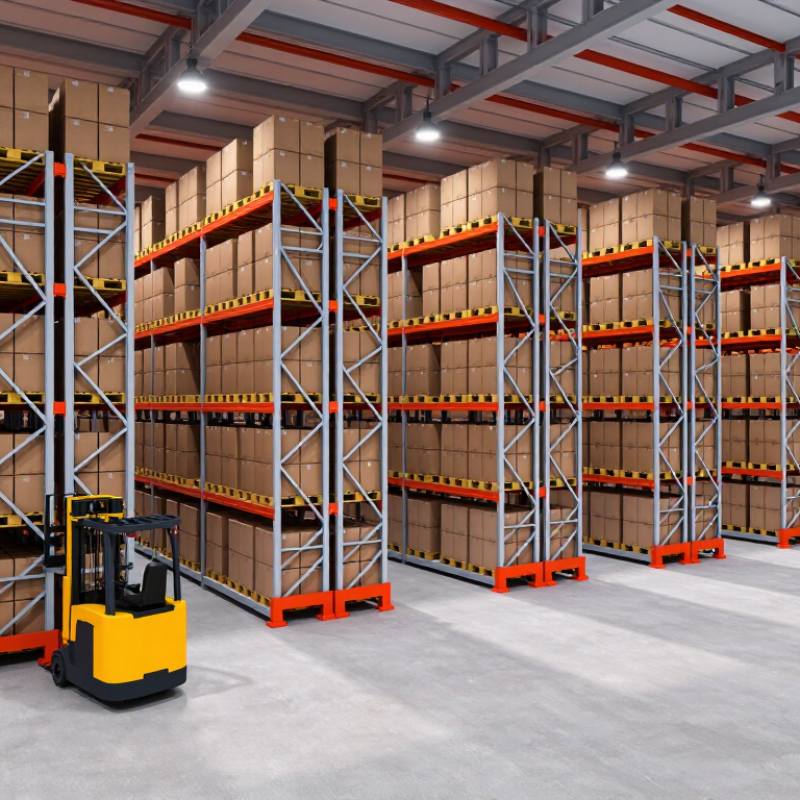
Heavy duty double deep pallet racking is a storage system that places two pallet positions deep on each side of an aisle. A suitable deep-reach truck retrieves pallets from the front position and reaches the rear position behind it. This layout stores more pallets within the same floor area than single-deep racking, while using fewer aisles.
Its core structure consists of load-bearing upright frames, horizontal beams, and deep-lane supports that hold the rear pallet. The frames carry vertical loads, while beams support pallet weight across each bay. Exact capacities depend on component dimensions, pallet size, load weight, and the rack’s configuration. A clear layout plan matters. Poorly matched pallets or equipment can make rear positions awkward to access. It is not a perfect fit: workers generally need to move the front pallet to reach the one behind it, so direct access to every load is limited.
Tips
Check that pallets are consistent in size and condition, and confirm the reach truck can serve the full depth. Keep loads stable and centered on the beams. Label lanes clearly, inspect for impact damage, and follow the system’s rated capacities. Small details matter. A site assessment by a qualified racking professional can help verify aisle widths, clearances, and loading requirements before installation.
Double deep racking stores two pallets, one behind the other, in each rack position. A reach truck with an extending mechanism places the rear pallet first, then positions the front pallet. Retrieval reverses the sequence: the front pallet must move before the rear one can come out. That extra step matters. The system suits warehouses holding several pallets of the same product, where access to every pallet is less urgent than using floor space efficiently.
The operator needs a truck designed for double-deep access, clear aisle markings, and accurate load placement. Forks extend into the rack, so pallet condition and load stability deserve close attention. A damaged pallet at the front can block access to the one behind it.
That trend highlights a practical point: storage design and handling equipment must work together, even when retrieval remains manual. Double deep can increase storage density, but it reduces direct access and may complicate stock rotation. It is not always the better choice. Warehouses should test aisle width, pallet mix, and retrieval frequency against actual operating patterns before committing.
What Is Heavy Duty Double Deep Pallet Racking?
Key Components and Load Capacity Considerations
Double deep racking stores two pallets behind each other, reducing aisle space but limiting direct access to rear loads. Its main components are uprights, horizontal beams, bracing, row spacers, anchors, and load-supporting decking or rails. The exact layout matters. A beam pair’s capacity depends on its span and load distribution, while frame capacity depends on height, bracing, and the distance between loaded beam levels. The RMI/ANSI MH16.1-2023 standard sets engineering criteria for steel storage racks; it does not provide one universal rating for every rack configuration. Capacity must match the installed design.
Check pallet weight and dimensions, beam elevations, floor condition, and equipment clearance before loading. Add the front and rear pallet positions together when assessing each beam level, and keep loads evenly distributed. A heavy pallet placed off-center can change how forces reach the beams and uprights. Small details matter. MHI’s 2024 Annual Industry Report found that 55% of surveyed supply-chain professionals planned to adopt robotics and automation within five years. If handling equipment changes, verify clearances and rack design again. A capacity sign is useful, but it cannot correct an unverified layout. In practice, warehouse teams should compare actual loads with the rack supplier’s engineered capacity documents and flag bent members or loose anchors promptly. Real sites are messy. Pallets vary, and inspections can miss damage.
Double deep pallet racking stores pallets two positions deep, allowing higher storage density than single-deep selective racking. A reach truck or specialized double-deep forklift is normally required to place and retrieve the rear pallet.
Frames, uprights, horizontal beams, pallet supports, spacers, row spacers, and floor anchors form the main structure.
Rated capacity depends on beam length, upright height, steel section, pallet dimensions, load distribution, and the number of beam levels.
The values shown are representative planning figures, not design approvals. A qualified engineer must verify the rack system for the intended site and load.
What Is Heavy Duty Double Deep Pallet Racking?
Benefits and Operational Limitations
Heavy-duty double-deep pallet racking stores two pallets behind each other in each lane. It can increase storage density by reducing the number of aisles, especially when a warehouse holds multiple pallets of the same product. Fewer aisles may leave more room for staging. The actual gain depends on the building layout, truck maneuvering space, and usable height. A floor plan alone cannot confirm operational fit.
Access is the main trade-off. The front pallet must be moved before workers can reach the rear one. This can slow mixed-product picking and complicate stock rotation. Operators also need compatible deep-reach trucks and clear sightlines when placing loads. A damaged or misaligned pallet can make retrieval difficult. Teams sometimes underestimate training and put-away discipline; congestion can follow. Capacity varies with pallet dimensions, beam levels, and frame design, so verify the specifications for the intended loads.
Tips: Compare aisle plans using actual truck dimensions. Test a lane with representative pallets before committing. Track retrieval delays during a busy shift; a layout that looks efficient on paper may feel different in daily use.
Heavy duty double deep pallet racking stores pallets two positions deep, reducing aisle space and increasing storage density. It suits warehouses handling multiple pallets of the same product, where stock rotation and access planning are manageable. A compatible deep-reach truck is usually needed to place and retrieve pallets at the rear. That can slow access to individual loads. For mixed, fast-moving stock, the space savings may not justify the extra handling.
Safety starts with a layout designed for the actual pallet sizes, load weights, floor conditions, and lifting equipment. Follow the rack supplier’s rated capacities, and display load notices where operators can see them. Keep pallets centered and stable. Never exceed beam limits. Trained staff should check frames, beams, connectors, and anchors for impact damage or movement, especially after a forklift collision. Remove damaged sections from service until a qualified person assesses them. Use suitable column guards, but do not let guards hide damage. Keep aisles clear, and make sure operators can see during deep placement. Small misalignments are easy to miss. Regular inspection helps, though it cannot replace careful loading and well-trained operators.
| Topic | Key Information | Practical Consideration |
|---|---|---|
| System definition | Double deep pallet racking stores pallets two positions deep on each side of an aisle, using paired rack rows or a purpose-designed arrangement. | Access to the rear pallet is restricted while a pallet is stored in the front position. |
| How pallets are accessed | A compatible deep-reach truck or other suitable material-handling equipment places and retrieves pallets in the rear and front positions. | Confirm equipment reach, lift height, aisle requirements, and pallet dimensions before designing the layout. |
| Typical applications | Can suit warehouses storing multiple pallets of the same product, operations with relatively predictable stock rotation, and facilities seeking more storage positions within a given floor area. | Assess inventory mix and retrieval frequency; improved storage density may come with reduced direct access to individual pallets. |
| Inventory management | Works best when pallet loads can be managed in a planned sequence, such as storing matching products in the same lane. | Consider stock rotation rules, lot tracking, expiry dates, and how staff will retrieve the correct pallet from the rear position. |
| Storage capacity | Capacity depends on the rack design, beam and frame components, pallet dimensions, load distribution, and site conditions. | Use the rack supplier’s approved load information and the site-specific design; do not assume a universal capacity. |
| Load placement | Pallets should be stable, compatible with the rack, and positioned as specified by the rack design and operating procedures. | Keep loads within posted limits and avoid overhang, uneven loading, or placing damaged pallets into storage. |
| Rack protection and inspection | Inspect uprights, beams, connectors, baseplates, anchors, and protective barriers for visible damage or displacement. | Report damage promptly, restrict access where there may be an immediate hazard, and have repairs assessed by a competent professional. |
| Forklift operation | Operators need training and equipment suitable for the rack layout and the intended pallet loads. | Follow site traffic rules, travel at controlled speeds, maintain clear sightlines, and avoid striking rack components. |
| Seismic and site conditions | Required rack design and anchorage can vary with local building codes, seismic conditions, floor characteristics, and building layout. | Have the installation reviewed for the specific site and applicable regulations; do not modify or relocate components without approval. |
| Housekeeping and access | Clear aisles and unobstructed access support safer truck movement and emergency response. | Keep aisles, exits, sprinkler systems, and fire equipment clear in accordance with site rules and applicable requirements. |
It stores two pallets behind one another in each rack position. This design saves aisle space.
A deep-reach truck places the rear pallet first. It then positions the front pallet carefully.
The front pallet must leave before the rear pallet can be removed. Access is slower.
It suits warehouses holding several pallets of the same product. Access planning must be manageable.
Not always. Frequent retrieval may cancel out the space savings and create extra handling.
Operators usually need a truck with extending forks. Clear aisle markings and accurate placement are also important.
Pallets must remain stable, centered, and undamaged. A broken front pallet can block the load behind it.
Check frames, beams, connectors, anchors, and floor conditions regularly. Inspect again after any forklift impact.
Remove damaged sections from service. A qualified person should assess them before reuse.
Test aisle width, pallet sizes, load weights, and retrieval frequency against real operating patterns. Assumptions can be wrong.
Heavy Duty Double Deep Pallet Racking is a storage system that places pallets two positions deep on each side of an aisle, increasing storage density compared with single-deep layouts. Its design typically uses robust frames, beams, and guided support rails to hold substantial loads. Because the rear pallet is less accessible, operators generally use a suitable reach truck or specialized handling equipment to place and retrieve pallets in sequence.
The system can make effective use of available floor space, but it may reduce selectivity and require careful inventory planning, since accessing a rear pallet can involve moving the pallet in front. Capacity depends on rack configuration, pallet dimensions, load weight, and the condition of components, so these factors should be assessed before installation and use. Heavy Duty Double Deep Pallet Racking is often suitable for facilities storing larger quantities of similar products. Safe operation depends on trained equipment operators, clear aisles, visible load limits, routine inspections, and prompt attention to damage.