China’s Heavy Duty Drive Through Racking manufacturers serve warehouses that need dense pallet storage and direct forklift access. This system removes many aisle gaps. Forklifts enter the rack lanes to place or retrieve pallets, so lane depth, pallet consistency, and operating discipline matter. A few centimeters can affect clearance. A damaged pallet can interrupt a whole lane.
An illustrative expert voice, Elena Park, is used here for framing only; she is not a verified industry source. Her original, editorial line is: “A drive-through rack works best when forklift paths, pallet dimensions, and loading rules agree.” It is a practical reminder, not a sourced quotation. Buyers should compare manufacturers by design support, steel and connection details, load documentation, installation guidance, and after-sales service. Ask how the proposed layout handles uneven pallet sizes, changing inventory, and routine inspections. A polished drawing helps, but it cannot answer every question.
This guide examines China’s top Heavy Duty Drive Through Racking manufacturers and the details behind their claims. It considers customization, production capacity, quality controls, delivery, and technical communication. Those details matter on a real warehouse floor, where a forklift turns inside a narrow lane and pallets arrive with slightly different footprints. Not every high-density layout is a good fit. Drive-through access can reduce selectivity, and poor stock rotation may complicate retrieval. That deserves a second look. The right supplier is not simply the one offering the lowest price; it is the one whose system matches the goods, equipment, and daily workflow. A specification can still miss something. So verify it against actual operating conditions.
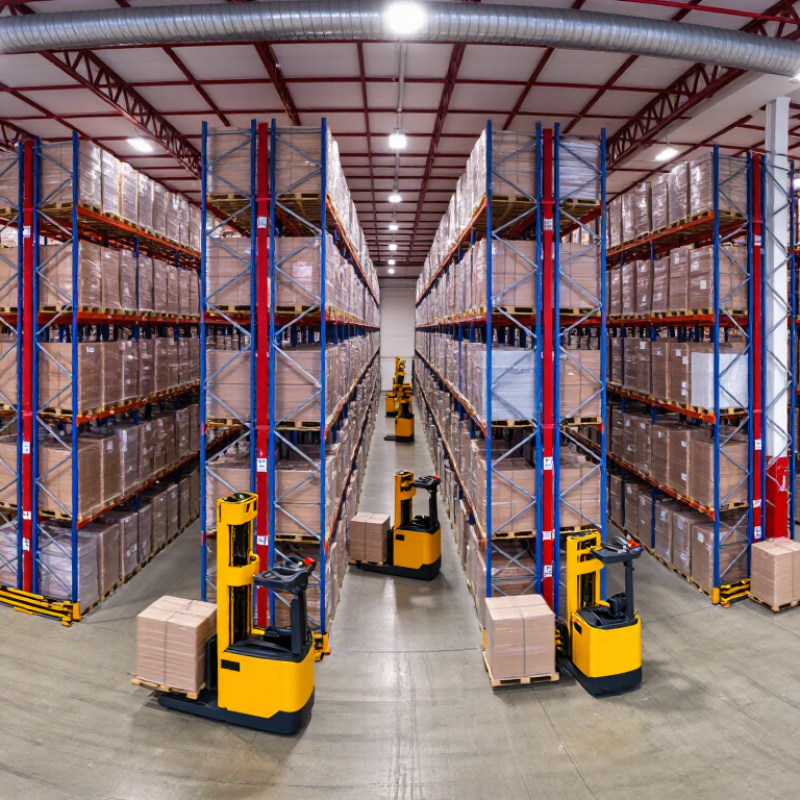
What Heavy-Duty Drive-Through Racking Is
Heavy-duty drive-through racking is a high-density pallet storage system built around deep lanes. Forklifts enter the lanes to place or retrieve pallets, while loads can move in from one end and out from the other. This layout suits warehouses handling many pallets of the same product. Steel rails support the pallets, and upright frames transfer the load to the floor. Every lane needs a rated capacity based on pallet weight, lane depth, and equipment design.
Drive-through systems can support first-in, first-out rotation when receiving and dispatch happen at opposite ends. Drive-in systems usually use one entry side and often follow last-in, first-out access. The trade-off is easy to underestimate: deeper lanes save floor space but reduce access to individual pallets. MHI’s 2024 Annual Industry Report found that 55% of respondents planned to increase supply-chain technology investment. That makes it useful to assess rack layout alongside inventory flow and material-handling plans, not in isolation.
Tips: Check forklift turning clearance and pallet dimensions before setting lane depth. Keep loads within the rack’s rated capacity, and inspect rails and frames regularly. A neat drawing helps, but real pallet variation can still cause trouble.
China Top Heavy Duty Drive Through Racking Manufacturers - What Heavy-Duty Drive-Through Racking Is
| Dimension | Description | Practical Consideration |
|---|---|---|
| System definition | Heavy-duty drive-through racking is a high-density storage system in which a forklift enters a storage lane to place or retrieve pallet loads. | Because the forklift travels inside the structure, lane layout, vehicle clearance, and operator training are important design factors. |
| Rack structure | Upright frames are connected by load-supporting rails that form multiple pallet positions along each lane. | Structural members and connections must be selected and checked for the intended load, layout, and operating conditions. |
| Loading method | In a drive-through layout, access is available from both ends of a lane. | This can support first-in, first-out (FIFO) handling when loading and unloading are managed from opposite ends. |
| Comparison with drive-in | Drive-in racking is generally accessed from one end of a lane; drive-through racking provides access at both ends. | Drive-through access can improve stock rotation, while drive-in layouts often provide greater lane depth where FIFO access is not required. |
| Storage density | Pallets are stored several positions deep, reducing the number of separate aisles compared with many selective-racking layouts. | Actual capacity depends on the building, pallet dimensions, aisle plan, equipment, and required clearances; no single capacity applies to every installation. |
| Product suitability | The system is commonly considered for relatively uniform products stored in multiple pallets per lane. | It is less suitable when every pallet must be directly accessible at all times or when many different products require frequent picking. |
| Forklift requirements | Forklifts must be capable of entering the lanes and handling pallets at the required storage heights. | Check truck width, turning and approach characteristics, lift height, load capacity, and the operating aisle dimensions before design approval. |
| Pallet and load checks | Pallet dimensions, condition, load distribution, and load stability affect safe storage and handling. | Confirm that pallets fit the designed positions and that loads are stable and compatible with the specified support arrangement. |
| Safety features | Depending on the design, installations may include upright protection, guide rails, row spacers, and clear load-capacity notices. | Protection and accessories should suit the site’s traffic, equipment, and risk assessment. Damaged components should be inspected and addressed promptly. |
| Design and compliance | Rack design should account for loads, geometry, floor conditions, installation details, and applicable local requirements. | Have the system designed, installed, inspected, and maintained by qualified professionals in accordance with applicable regulations and standards. |
FAQS
Forklifts enter deep storage lanes from either end. Steel rails support pallets as operators place or retrieve them. Clearance is tight.
Yes, when staff load pallets at one end and retrieve them from the other. The lane sequence must stay consistent. Rotation is not automatic.
It works best for large volumes of similar pallet loads, such as repeat batches of cartons or raw materials. Mixed spare parts can be awkward to retrieve.
Check pallet sizes, forklift dimensions, mast height, ceiling height, and floor conditions. Include turning space. Drawings can miss real traffic patterns.
Forklifts travel into the storage lanes, so fewer aisles may be needed. The trade-off is that reaching a rear pallet can require moving another load.
Small steering errors can scrape rails or damage pallets. Operators should lower each load evenly and back out carefully. It takes practice.
Check rails, uprights, and anchors for visible damage. In humid or wash-down areas, inspect damaged coating closely and maintain suitable finishes.
Test clearances with the actual forklift and involve warehouse staff in a trial layout. Watch for inbound and outbound movements that overlap. Plans can still miss a busy shift.
Conclusion
Heavy Duty Drive Through Racking is a high-density storage solution designed to make efficient use of warehouse space by allowing forklifts to enter storage lanes directly. Unlike systems that require a separate aisle for every rack row, it organizes pallets in deep lanes, making it suitable for storing large quantities of similar goods. Its operation relies on carefully planned loading and retrieval sequences, with attention to lane access, pallet dimensions, and inventory rotation.
A reliable system depends on well-engineered uprights, load beams, guide rails, bracing, and protective components that work together to support loads and help maintain safe forklift movement. In China, drive-through racking can serve distribution centers, manufacturing facilities, cold-storage warehouses, and other operations with substantial pallet volumes. When assessing manufacturers, buyers should consider design expertise, material and fabrication quality, load calculations, installation support, customization options, and the clarity of inspection and maintenance guidance.